Farmers begin to gradually sow the seeds of change
 0 Comment(s)
 Print
Print E-mail
China Daily, January 4, 2012
E-mail
China Daily, January 4, 2012


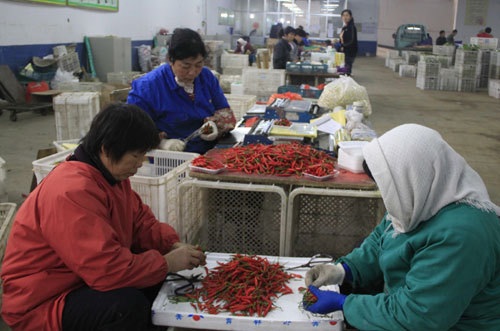 |
| Workers at a distribution center in Shouguang city, Shandong province, select hot peppers for supermarkets. Shouguang has annual vegetable yield worth 4 billion yuan. Seeds companies around the world eye the big Chinese vegetable center. |
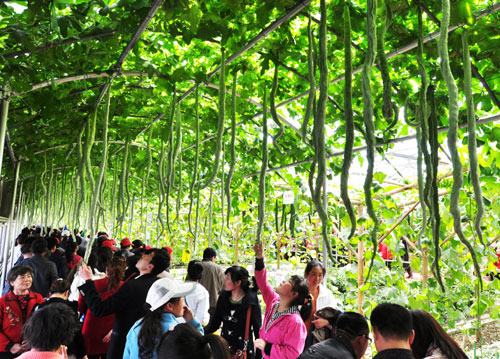 |
| People visit a vegetable expo held in Shouguang, Shandong province in April. |
Liu Mingshan, a farmer in Daotian township in Shouguang, the country's leading vegetable producer, said he prefers foreign seeds to domestic ones. "They are higher yielding and more resistant to disease than those developed by Chinese firms."
The veteran greenhouse vegetable grower pointed to a hybrid fruit cucumber from a Republic of Korea company. "It tastes great and sells well."
Bitter news, perhaps, for some agriculture officials and breeders. Foreign varieties have taken more than half of the seed market for major greenhouse vegetables in Shouguang, in East China's Shandong province, and for higher-grade vegetables in China, according to the Ministry of Agriculture's seed management bureau. Industry insiders say, however, that the country should recognize competition renders more choices to farmers and consumers and spurs the fledgling seed industry.
Foreign businesses supply seeds for almost all of the greenhouse fruit cucumbers (with no thorns) and sweet peppers and 80 percent of tomatoes, eggplants and melons in Shouguang, a city of 1 million residents.
"Shouguang farmers have to spend 300 million yuan ($47 million) a year on imported seeds," Tang Mingtao, deputy chief of the city's science and technology bureau, told China Daily.
Two-thirds of the revenue to the local seed market goes to foreign companies, he said. And foreign seeds are distributed through Shouguang to other parts of Shandong, the largest vegetable-producing province in China.
With an annual vegetable yield worth 4 billion yuan, Shouguang is the "vegetable city" that multinational seed companies cannot afford to neglect.
A speedy response
The world's top 10 seed companies, including Switzerland's Syngenta, the Netherlands' Rijk Zwaan and Israel's Hazera, are active players in the Chinese market. They have set up breeding bases or research facilities in Shouguang.
In July 2009, when tomato yellow leaf curl virus overran the greenhouses in Shandong, not one Chinese seed businesses could provide a timely solution, Tang said.
Hazera Genetics, which entered China in 1999, provided tomato varieties resistant to the virus within a few weeks, allowing local growers to re-sow soon, said Yossi Tzuri, Hazera China's CEO.
The price of the virus-resistant seeds and strains was more than double that for earlier versions of tomato, Tang said.
This anecdote and others are so deeply rooted in the minds of some local growers that they have grown to distrust Chinese vegetable brands, said Shen Huolin, dean of the vegetable science department at China Agricultural University in Beijing.
After 12 years of research and development, the professor and his team cultivated a premium long horn-shaped chili pepper variety, known as Zhongshou-12, that is proven better than its foreign counterparts in product quality and resistance to pests and disease.
"When a zealous farmer came to me for more seeds after a trial run," Shen said, "I offered a discount, which was half the price of foreign pepper seeds. To my chagrin, he said that since it was not a foreign make, the price should be still lower!"


Go to Forum >>0 Comment(s)