 |
|
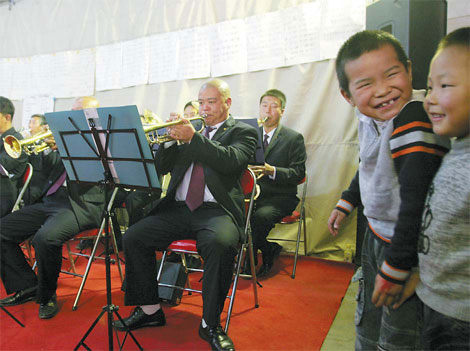
The orchestra in Anlitun village is popular among locals and even youngsters flock to its shows. [Jiang Dong/China Daily] |
The thick green curtain rises and Han Zhijun, 59, walks to the center of a wooden stage and starts to sing Hebei Bangzi (a folk opera popular in Hebei province), to the beat of Chinese folk music instruments.
The opera is based on a story from the Tang Dynasty (AD 618-907). Han plays Qin Ying, an emperor's grandson who is sentenced to death for killing the father of the emperor's favorite concubine.
As the story reaches its climax, Han, dressed in a golden robe emblazoned with dramatic dragon patterns, is immersed in his role, his sad eyes making him every bit the desperate noble man begging for the emperor's mercy.
Like Han, all 38 actors in the folk opera troupe are farmers in Anli, a village with a population of 2,000 in Wen'an county, Hebei province.
About two hours' drive from Beijing, the area has vast cotton fields that are now ready for harvesting and look like they are covered by a blanket of snow.
In 1997, villagers in Anli founded an opera troupe, which often presents operas in festivals and tours across villages in Wen'an.
Han and other members of the troupe are rehearsing for a seven-day show during Spring Festival late next January.
Passion for opera is not new to Anli. Over the past few decades, villagers have built a tradition of performing Hebei Bangzi, even during the "cultural revolution" (1966-76), when folk operas were regarded as "remaining poisons from the feudal society".
Yin Zhifeng, 77, is the eldest member of the troupe. He can't sing as he used to but he still plays erhu (a two-stringed fiddle) behind the curtain.
He says villagers set up their own opera troupe in 1949, donating corn and wheat from their limited food supply to support the singers. "We sold the food to make costumes and props," Yin says.
In winter, Yin and other actors stuffed pancakes inside their coats and went to perform in other villages in Wen'an.
In 1954, Yin went to Beijing and watched Peking Opera in a 4,000-seat hall in Gaobeidian. "They sold tickets for 0.25 yuan each - that was unbelievable for me," he says.
"Villagers didn't pay to watch opera. Instead, they invited us to have meals with them. We didn't perform for money. We only performed because we were proud of performing for them."
The village opera troupe met once a week to rehearse, even during the busiest harvest time. Song Zhizeng, 63, founder of the Anli Opera Troupe, holds up an old costume box and laughs as he recalls that if someone didn't turn up, the others would carry it to his home and play jokes on him.
During the "cultural revolution", the singers hid their costumes with relatives of the soldiers who died during the War of Liberation (1945-49), since the "red guards" did not usually ransack their homes.
After the opening-up and reforms, Wen'an became one of the biggest steel markets in China and local people started making a fortune from trading and processing steel and construction materials.
"Villagers rushed to make money and didn't have time to watch traditional operas any more," Song says. "They had many options to entertain themselves and some of them turned to gambling."
During the early 1990s, Han Zhijun opened a small steel workshop and hired 20 workers. "When I became rich, I was addicted to gambling like many villagers," he says.
"The more I lost, the more I wanted to continue."
He once lost 60,000 yuan ($8,570) in a night but still couldn't give it up. Another time he snuck home late one night and his wife jumped out of bed, crying and swearing she would divorce him.
He finally managed to give up gambling when he joined the opera troupe. "I felt happy singing with my friends," Han says, smiling.
In 1997, Song Zhizeng and his brother Song Zhiqiang, owner of the biggest steel factory in Anli, invested 800,000 yuan ($114,000) to establish the Anli Opera Troupe.
"I missed the old days when we were together singing operas," says Song Zhizeng. "We are rich now but we mustn't lose our traditions."
Although the members are all voluntary, they charge 2,000 yuan ($285) per show to make ends meet. A new costume costs 10,000 yuan ($1,425) and they must also maintain the props like the mobile stage.
In 2003, villagers in Anli raised 2.8 million yuan ($400,000) to build a new concert hall, which shelters the audience from sun and rain. In recent years, some of Anli's best young singers have been recruited by famous troupes in Beijing and Tianjin.
"I know Peking Opera has become an optional class in middle schools in Beijing and we must preserve our culture," Song Zhiqiang says.
(China Daily November 19, 2008)