 |
|
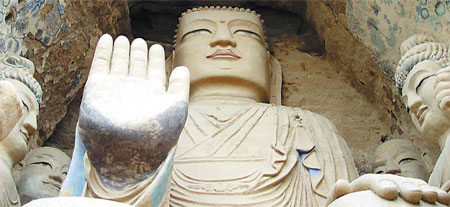
Relics at the Mogao Grottoes, Gansu province, reflect the golden age of the Tang Dynasty (AD 618-907). A new study shows this prosperous kingdom fell in concert with climate changes about 1,000 years ago. [Cao Zhizheng] |
A China-US research team recently established a strong correlation between Asia's summer monsoon and China's historical events. It also found proof of human-induced climate change.
Led by Zhang Pingzhong from Lanzhou University, the scientists recently reported in Science that weakening summer monsoons were associated with the demise of the Tang, Yuan and Ming dynasties.
Zhang and his team members recovered a 1,810-year-old 11.8-cm-long stalagmite from the Wanxiang Cave in Northwest China's Gansu province, where Asian monsoons currently travel.
"Summer monsoon winds originate in the Indian Ocean and sweep into China," Hai Cheng, co-author from the University of Minnesota, said in an interview with the BBC. "When the summer monsoon is stronger, it pushes farther northwest in China."
By measuring amounts of the elements uranium and thorium throughout the stalagmite and analyzing the "signatures" of two forms of oxygen in the stalagmite, the researchers linked the monsoon variation to the dates when several Chinese dynasties boomed and declined.
More importantly, a link was also found between the fluctuation of monsoon periods and cultural change in Europe and America, according to Larry Edwards, geologist at the University of Minnesota and also a co-author of the paper.
For instance, the weak summer monsoon periods between AD 850 and 940 coincided with the last six decades of the Tang Dynasty (AD 618-907), the researchers wrote in the paper. Lower monsoon power reduced the rainfall and may have led to less harvest, which could have sparked unrest and led to the downfall of Tang, they suggested.
This dry period also happened during the decline of the Mayans in Mesoamerica.
In another example, the summer monsoon strengthened between 960 and 1020, coinciding with the first six decades of the Northern Song Dynasty (960-1127), when rice cultivation thrived and society was stable.
The researchers wrote: "The summer monsoon correlates with solar variability, Northern Hemisphere and Chinese temperature, Alpine glacial retreat and Chinese cultural changes."
The result echoes a previous study by Chinese and German paleoclimatologists, who found a correlation between weaker monsoons and the demise of the Tang Dynasty, after analyzing the magnetic properties and titanium content of the sediments of a lake in southwestern China.
"Our study suggests that climate change has affected a good portion of the global culture," Edwards said.
Another major finding of this study is the change in the correlation between temperature and the Asian monsoons since 1960.
Before this year, said the scientists, stronger Asian monsoons usually brought large precipitation but after it, stronger monsoons instead led to less rainfall in northwestern China.
The researchers linked the change mostly to man-made causes, including greenhouse gas accumulation and rising amounts of black carbon and sulfate aerosols.
Edwards said the team is now looking further back in time for more evidence of the association between climate change and human activities.
(China Daily November 21, 2008)