An industrial pollution control campaign has been set in motion
this year in Liaoning Province, one of China's old
industrial bases in the northeastern area, according to provincial
environmental protection bureau sources.
The provincial government will spend 7.3 billion yuan to bring
the pollution in certain key areas and industries under control
over a period of three years.
Environmental pollution has proven to be a hurdle in the
development of Liaoning's industries. In its efforts to address the
problem, the province will emphasize the control of river pollution
and shutting down paper-making plants and printing works that
seriously pollute the environment.
The pollution remediation campaign will focus on key industries
such as paper-making, painting and dyeing, thermal power,
metallurgy, and petrochemicals.
There are also 14 key areas that will receive special treatment.
The eight heavily polluted branches of Liaohe River and the
upstream area of Dalinghe River will see the establishment of
wastewater treatment facilities.
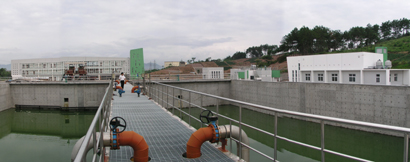
A sewage treatment plant in
Fenghua, Liaoning Province
In the central city cluster, the Haicheng and
Dashiqiao magnesium oxide polluted area, and the Jinzhou and
Huludao molybdenum iron smelting polluted area, the use of clean
energy like natural gas, liquefied petroleum gas and electricity
will be encouraged.
The aim of the pollution treatment scheme is to effectively
resolve the environmental problems that damage people's health,
improve regional environmental quality, and considerably reduce
total emission of pollutants by 2010.
When all 93 projects are implemented, the emission of sulfur
dioxide and smoke dust will be cut by 150,000 and 67,000 tons per
year respectively. Besides, dangerous waste treatment capacity will
increase by an additional 17.55 million tons.
Toward cleaner water
Shenyang has implemented a large-scale environmental protection
movement this month.
Corporations discharging wastewater that fails to meet concerned
standards will face a series of punitive measures. They may be put
on a blacklist, be required to resolve the problem over a limited
term, and be subjected to a huge fine. They will also face greater
difficulty in applying for bank loans.
A sewage treatment plant in
Jinzhou, Liaoning Province
Environmental protection bureaus at both the municipal and
district levels are taking swift and effective action to inspect
109 local enterprises that are regarded as the main wastewater
sources in the city.
The month-long campaign aims to punish the companies that
violate the environmental protection law. The names of firms
committing serious offences will be recorded by the credit system
of banks.
(China Daily October12, 2007)