What are added to Baghdad's usually tensional streets -- featured by countless checkpoints, blast walls and steel wire that fend off suicide and car bombs -- are more fully armed soldiers compounded with both US and Iraqi armed vehicles.
 |
|
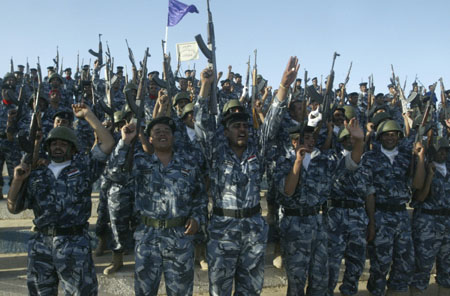
Iraqi policemen celebrate as they mark the US withdrawal from Iraqi cities, in Ramadi, 100 km (60 miles) west of Baghdad June 29, 2009.[Xinhua]
|
Dusty air that coincides with the shadow of terror by a series of deadly blasts that claimed more than 200 lives in the past few days still lingers.
People are told not to take to places of crowds, for fear of being the next victims. That's why people in uniforms -- US and Iraqi soldiers and police -- are largely the only visible here and there.
Fully armed Ahmad Sobhi fastened his helmet and windshield glasses while manning a machine gun on top of his pickup and scanning the dusty street.
For him, today is meaningful -- the last day he might cooperate with US soldiers, after which he will patrol in Baghdad streets with his Iraqi fellows only.
Thinking for guarding his own country and serve for his compatriots without the assistance of US counterparts, Sobhi seemingly felt the weight of responsibility assigned upon him.
Another Iraqi soldier came by and said with a perceivable sign of complexity to Xinhua correspondent that US soldiers will leave soon and they shall no longer see them in cities.
 |
|
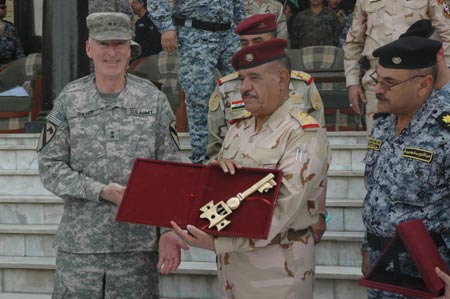
US General Daniel Bolger (1st L), commander of US forces in Baghdad, hands over a symbolic key to General Abud Qambar, commander of Baghdad Operation Command, during a hand-over ceremony in Baghdad, capital of Iraq, June 29, 2009. June 30 is the deadline for US combat troops to withdraw from major cities in Iraq. [Xinhua]
|
