June 30 is the deadline for US combat troops to leave Iraqi towns and cities, while August 2010 for all combat troops out from Iraq and no later than 2011 for all US soldiers, as stipulated in the Status of Forces Agreement (SOFA) sighed at the end of last year between Washington and Baghdad.
Despite the going of US soldiers, a series of deadly blasts across Iraq that have claimed more than 200 lives do not seem to shake Iraqi security forces' confidence.
Ali Ghedan, the infantry forces leader in Baghdad, told Xinhua that his forces spread from north to south, east to west, and in every spot across the country.
"We are able to conduct maneuvers from place to place, and we can reach any place terrorists might reach," he said.
Saleem Jubuli, a Sunni parliament member, cautioned the situation during his country's historical military handover, saying that he personally believed security situation would be affected, but temporarily.
"Hopefully, we will have a stable future," he said.
"Frankly, security situation will be covered by the Ministry of Defense, Ministry of Interior, the National Security Forces, and supported by all security systems in Iraq, in order to keep all stabilities in Iraq, especially in Baghdad," Fawzi Akram, a Shiite parliament member told Xinhua.
 |
|
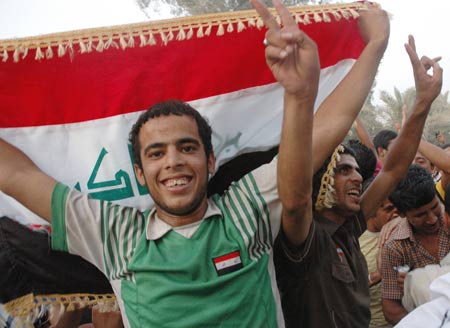
Iraqis celebrate the withdrawal of the US combat troops from Iraqi cities and towns in Baghdad, capital of Iraq, June 29, 2009. As part of a security pact signed between Baghdad and Washington last year, the US troops would withdraw from Iraqi cities, towns and villages by June 30, 2009 to their bases, and would leave the country on Dec. 31, 2011. [Gao Shan/Xinhua]
|
His optimism coincides with Farzam Ahamad, a Kurdish parliament member, who said that "I am optimistic, because Iraqi security forces have reached a level that is able to control securities in Iraqi cities."
The mission of the remaining US troops outside Iraqi towns and cities is shifting from combat to training and advising. They could, at Iraq's request, reenter cities for help in missions.
"Supports we need from Coalition Forces after the transfer are limited. We might need intelligence support, although our units do have some information about terrorists' movement, but we might still need such support from Coalition Forces due to their advanced technologies," said Ghedan.
When asked whether they will request US soldiers to come back into cities to conduct missions, Sobhi responded instantly, "we hope we will never raise such a request."
(Xinhua News Agency July 1, 2009)
