Tibetan tour guides pround of hometown
 0 Comments


Pasang from Bayi Town, Nyingchi County in southeast Tibet's Nyingchi Prefecture, is a tour guide of the local Thousand Year Walnut Tree Folk Custom and Culture Village.
She is now attending a training course for tour guides at the Zhaoqing Tourism School in south China's Guangdong Province.
|
|
|
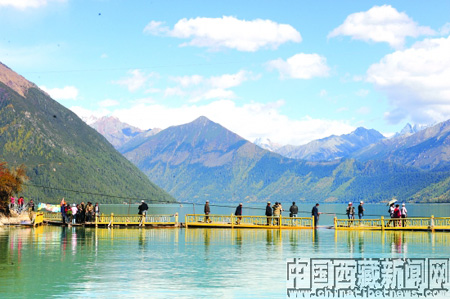
Tourists from China's inland cities enjoy sightseeing on the Basum Co Lake, Nyingchi Prefecture, southeastern Tibet. [Source: chinatibetnews.com] |
"When I was leading a tour group, I didn't have much confidence and my background narrations were not detailed, or rather quite fragmentary. Sometimes I even became impatient," she said.
"I've gained a lot confidence from the training course here and when I get back to work, I will tell about the unique features of the sites to every tourist with great patience."
The attendees of the training course include both officials or management staff from Tibet's tourism departments at various levels. Although they range in age from 40 to 20, "they are all the mainstay of Tibet's tour business," as Liao Qiyong, Pasang's head teacher, put it.
Nyingchi's tourism suffered an all-time low after the Lhasa riots that happened on March 14, 2008.
But in the following year, thanks to its rich resources, Nyingchi's tourism became booming again. According to statistics from the Tourism Bureau, by the end of October, Nyingchi had received more than one million tourist person times. It is expected to see a total of 1.2 million tourists by the year end.
Guangdong Province, a major financial and technology helper of the prefecture, is the main source of a largest number of tourists.
|
|
|
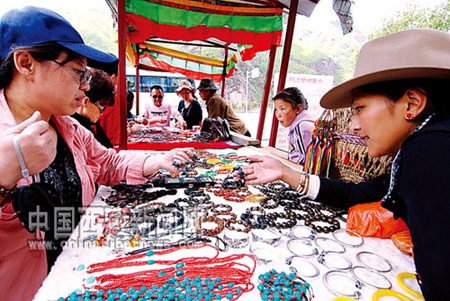
Tourists choose souvenirs in a scenic spot in Nagpoi Village, Gongbo Gyamda County, Nyingchi, southeastern Tibet. [Source: chinatibetnews.com] |
Zhang Liwen, organizer of the training course and a leading official of Nyingchi Tourism Bureau, said, with development in the prefecture's tourism, the professional skills and qualifications of people in the business appear lagged behind.
The training course, on the one hand, aims to improve their professional skills to enhance the development of the tourism, said Zhang, who himself is an aid-Tibet official from Guangdong.
On the other hand, he added, it also aims to promote the cultural and personnel exchanges between Tibet and Guangdong.
The training course does not only give lectures on scenic spots management, basic knowledge about tour guidance and background narration skills. It also runs field trips and on-the-spot coaching for the trainees.
Kelzang Dromla, who got out of Tibet the first time in her life, was very excited. "It is the first time for me to come to such a far-away place and I learned a lot from the training course," she said. "We went to a couple of scenic spots, such as the Seven Star Rock in Zhaoqing and the Panlong Gorge. They are so different from the scenic spots in my hometown. Ours are natural, but a lot of those here are man-made but fun."
Feeling there were not much to talk about her hometown before she attended the training course, now Dromla had different ideas. She realized there are so many unique and beautiful sceneries in her hometown. "I am proud of my hometown and I will let the visitors enjoy the beauty of it too," she said.
What impressed Pasang most during the 15-day field trip was not as much by the "man-made fun" as by the tour guides in the scenic areas of Gudong. Those people knew the places so well and appeared so confident in their work. "I asked them a lot of questions and they all answered with great details and patience. I have to learn from them," said Pasang.


Comments