Neiwubu Jie: bygone brothels and ancient mansions
 0 Comments


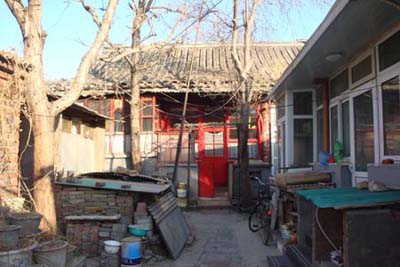
If you're looking for Neiwubu Jie, north of the busy intersection of Dongsi South Street and Jinbao Street, don't trust the signs. The west entrance to the hutong is 10 meters further north than indicated. Once you find it and enter, as with so many hutong, the hustle and bustle on the main street of Dongsi is replaced by a more serene busyness, that of old Beijingers walking and biking down the lane.
Ming Dynasty brothel
During the Ming Dynasty, the hutong's name, Goulan, reflected it's primary role as a street of brothels. In the book Heading for the Historical Sites of Beijing, historian Zhang Cixi explains, "Goulan Hutong used to have many brothels in the Yuan Dynasty. There was a big courtyard and a small temple inside. In the temple, a bronze statue of a seated woman is smiling. Dressed in a short gown, crossing her left leg, she looks pretty, coquettish and attractive." It is rare in history to mold a statue of a prostitute, but it is said to exist in Beijing, though the exact location of the statue is currently unknown.
When approaching from the west entrance, No. 67 is the first place one comes to with a "protected courtyard" plaque. The gap between the locked, gilded doors provides a glimpse of a chaotic courtyard. Could the statue be hidden within?
School for imperial families during the Qing Dynasty
No. 13 houses the Beijing No. 2 High School. The building was constructed in 1724 to serve children of the left wing imperial clans of the Qing Dynasty; later it became the Ministry of Home Affairs in Duan Qirui's Northern Warlord Government, a period that gave the hutong its name: Neiwubu Jie, or Ministry of Home Affairs Street. The big gray-stone gate, carved with exquisite reliefs, seems to tell passers by the long history of the school. At both sides of the gate, a pair of couplets read, "Enter to realize your dream, leave to go forth and serve society." The gray-white building is obscured by green plants and red lanterns. Students play on the playground, adding a layer of modernity and vitality on top of No. 13's glorious history.
Mansions of celebrities to homes of the ordinary
No. 11 used to serve as the residence of Fucha Mingrui during the Qing Dynasty. In 1759, Mingrui successfully put down the rebellion during Emperor Qianlong's reign and was knighted as duke. In 1834, his great-grandson Jingqing inherited his title of nobility. In 1845, Princess Shou'en Gulun, the sixth daughter of Emperor Daoguang, married Jingshou, younger brother of Jingqing, so later this house was called the "Mansion of the Sixth Princess." In the period of the Republic of China, Yue Qianzhai, president of the Salt Industry Bank Ltd., bought the quadrangle courtyard and lived there. In 1984, the courtyard became a site for historic preservation, and now several households live there. Only the signboards on the door indicate the building's past. A sign insists, "No visitors allowed." It seems the current residents are tired of those in search of the hutong's history.


Go to ForumComments