Trotting up the Wall
 0
0 


|
|
|
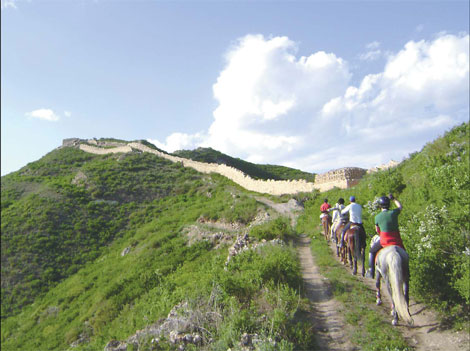
A horseback ride to the Yangbian Great Wall is the real deal for many aficionados who try to seek a rugged and pristine climb. Alexis Hooi /China Daily |
|
|
|
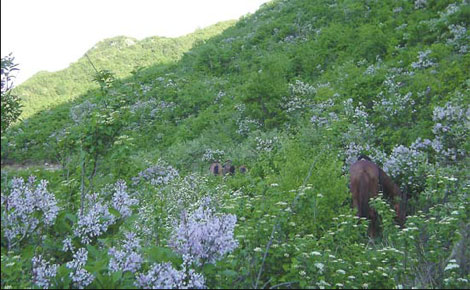
The horses are freed on the slope to recharge on the fresh mountain grass. Alexis Hooi / China Daily |
Feasting on the Great Wall under the stars is the stuff of dreams for many visitors to Beijing. Alexis Hooi takes the experience further by joining a group of horseback riders to scale a little-known but historic section of the fortification.
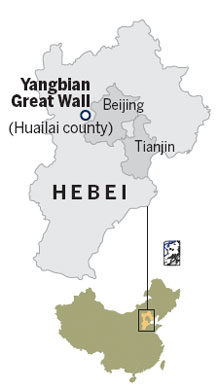
Less than 100 km northwest of downtown Beijing lies the Yangbian section of the Great Wall, in Huailai county of Hebei province. Unlike more popular sites such as Badaling and Mutianyu, this part of the wall stands broken and remains untouched by renovation. As such, Yangbian is the real deal for many Great Wall aficionados seeking a rugged and pristine climb up one of the wonders of the world.Yangbian also offers an interesting nugget for the history buff.
A number of historians armed with comparative photographs claim that it was through this part - and not the famous Juyongguan pass - that Japanese troops broke through on Aug 20, 1937, during the initial stages of the War of Resistance against Japanese Aggression.
All these seemed too good to resist for our group of a dozen horseback riders, who decide to explore one route to Yangbian this summer.
We set off from Taishizhuang village near the Guanting reservoir, where the Yeshulin equestrian club prepare our steeds and supplies for the two-day trek.
Guanting reservoir, located in Beijing's Yanqing county, is a popular weekend destination for many Beijingers wanting to get away from the city to enjoy nature. Rows of humming wind turbines tower above the banks of the reservoir, acting as green sentinels to a water source that became unfit for drinking decades ago because of pollution and is now only suitable for agricultural use.
On a clear day, the mountain ranges further in the northwest form a breathtaking backdrop for the glistening surface of the reservoir. The waters also support waterfowl paddling among clumps of reeds that help break gentle waves lapping against the shores.
After a bracing ride along the southern edge of Guanting, the scenery change dramatically as we arrive at the Tianmo desert area. The patch of sand is the closest of its kind to the capital and is usually used by film crews to shoot desert scenes. Fueled by a brief beer stop at a farmer's shack on the fringe of Tianmo, a few riders blazing ahead at the front of our team chance upon prop villages complete with earthen ramparts and tower gates.
Liang Cheng, a 45-year-old local farmer, says it is common to come across actors, directors, producers and other film personnel in the area's lodgings during a set production.


Go to Forum >>0 Comments