Report fires back at military coverage
 0 Comment(s)
 Print
Print E-mail China Daily, June 6, 2012


Feedback sought
The report was not influenced by the Chinese government or military establishment and all the information cited came from the websites of the US and Japanese defense ministries, according to Luo.
Despite being a former deputy head of the department of global military studies at the Academy of Military Science, Luo said that his role in the report was that of a scholar working in collaboration with prominent Chinese experts on the US, Japan and military studies. "We are doing our best to objectively introduce the thoughts, power and implementation of the US and Japanese militaries," he said. "I'm not concerned about criticism that we are exaggerating the threat. We are simply telling the truth."
Launched in January 2011, the CSCPA hopes that the conclusions drawn in the two reports will be disseminated through the media and at international conferences and exchanges to prompt feedback from research fellows overseas.
Chinese authorities have yet to comment on the reports, but a government source, who asked not to be named, said they do not necessarily reflect the attitude of the authorities in Beijing.
Jin Canrong, deputy dean of the School of International Studies at Renmin University of China, said he was pleased to see the reports being published, and that they will "have a relatively low negative impact politically, compared with official documents".
"These reports have a special significance for civil think tanks in China," said Yu Lian, deputy head of the CSCPA, "To survive and develop, these organizations have to be fair and objective. We hope that a great many people around the world will hear our voice."
Military overview
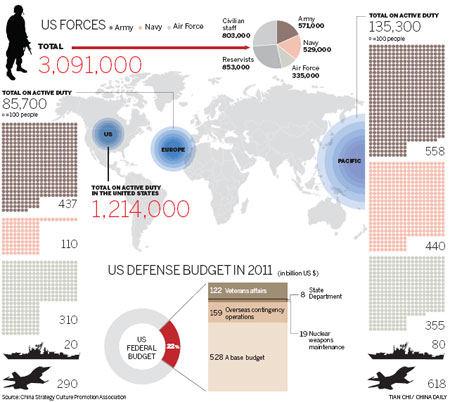
In addition to assessing the Pentagon's strategy with regard to China, the report also provided an overview of the US military, ranging from armaments to troop deployment. "Our assessment of US military might in the past two years showed that although the wars in Afghanistan and Iraq, plus the financial crisis, have put the comprehensive strength of the US under severe pressure, so far their impact on US military capability has been impossible to gauge," it said.
"The US military is still the strongest in the world, capable of handling two relatively large-scale regional wars and some small-scale contingency operations at the same time," continued the report, adding, "It (the military) can also provide strong support for the US' strategic pivot shift to the East."
As for the strategic weapons reductions treaty between Washington and Moscow, which will see the US reduce the number of nuclear warheads it deploys to fewer than 1,550 in the next decade, the report said it "will not seriously hamper the nuclear deterrent capability of the US military".
On the contrary, the authors believed that the US military and conservative forces are against the idea of a "nuclear-free world", and concluded "it is doubtful that the US government will really implement the proposal".
Tough stance
Meanwhile, the CSCPA report on Japanese military might said Tokyo has taken a number of steps that have provoked disputes with Beijing, including shifting its military focus to its southwestern islands and areas such as the Diaoyu Islands, which belong to China but are the subject of territorial claims by the Japanese.
The JSDF has also "closely followed, watched and even disturbed" Chinese naval vessels engaged in training exercises in the waters near Okinawa and have taken a "tougher and tougher stance" on the Diaoyu Islands issue, according to the report.
In addition, Japan has excluded China and Russia from its multilateral security cooperation system, a grouping of countries that includes the US, South Korea, Australia, India and some Southeast-Asian nations, it said.
The report noted remarks made by the Japanese Prime Minister Yoshihiko Noda in October 2011 that Pyongyang and Beijing have added to the "opaqueness of Japan's security environment" and his statement that "although it is peaceful at present, dangers will come if we forget about war".
"Who is the target of this 'war'?" asked Luo. "That attitude has exerted pressure on the regional security environment and has cast a shadow over Sino-Japan relations."
Talking about other aspects of the JSDF, the report concluded that it is a well-trained medium-scale military with abundant budgetary resources and advanced technologies, which are being employed at a "critical time in its military transformation".
Honesty is paramount
Fu Liqun, member of the research group of the CSCPA report, said honesty is the first step in resolving the mutual distrust between Beijing and Washington, and Tokyo. "We have to tell the truth. Take the US for example, it is a country that is used to getting its own way, and China should not always remain silent about important issues."
It is the same in trade disputes, he said, adding that Washington "always talks about its unemployment rate, but rarely takes the livelihoods of the 1.3 billion people in China into consideration".
"That is a big problem for the whole world," he said. "The ideal pattern is that I leave space for you, and you also leave space for me."
Moreover, the Pentagon also needs to reflect on its "outdated" concept of security, said Fu. "It (the US) believes that only the strong survive, not in mutually beneficial results. It is basically what we call a 'zero-sum game' nowadays."
If Washington maintains that attitude towards Beijing, it will always feel threatened by a rapidly growing China and will squander many opportunities for cooperation, he said. "Healthy ties between Beijing and the US should comprise normal competitive relations, where both sides are satisfied with the results."
Fu believed that Washington needs to make the first steps to achieving that aim because "a strong country always takes a leading role in promoting bilateral mutual trust".


Go to Forum >>0 Comment(s)