 Share:

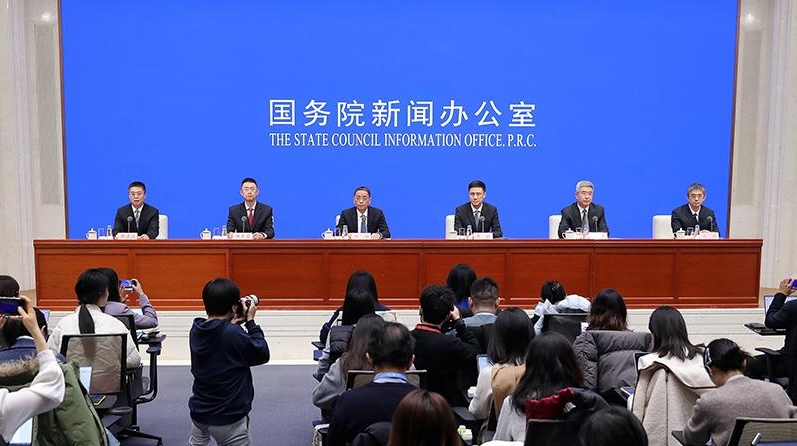
Speakers:
Mr. Zou Lan, spokesperson and deputy governor of the People's Bank of China (PBC)
Mr. Li Bin, spokesperson and deputy administrator of the State Administration of Foreign Exchange (SAFE)
Mr. Xie Guangqi, director general of the Monetary Policy Department of the PBC
Mr. Yan Xiandong, spokesperson of the PBC and director general of the Statistics and Analysis Department of the PBC
Mr. Xiao Sheng, director general of the Capital Account Management Department of the SAFE
Chairperson:
Mr. Zhou Jianshe, deputy director general of the Press Bureau of the State Council Information Office (SCIO) and spokesperson of the SCIO
Date:
Jan. 15, 2026
Zhou Jianshe:
Ladies and gentlemen, good afternoon. Welcome to this press conference held by the State Council Information Office (SCIO). Today, we have invited Mr. Zou Lan, spokesperson and deputy governor of the People's Bank of China (PBC), and Mr. Li Bin, spokesperson and deputy administrator of the State Administration of Foreign Exchange (SAFE), to introduce the effects of monetary and financial policies on high-quality development of the real economy and to answer your questions. Also present at today's press conference are: Mr. Xie Guangqi, director general of the Monetary Policy Department of the PBC; Mr. Yan Xiandong, spokesperson of the PBC and director general of the Statistics and Analysis Department of the PBC; and Mr. Xiao Sheng, director general of the Capital Account Management Department of the SAFE.
Now, I'll give the floor to Mr. Zou for his introduction.
Zou Lan:
Good afternoon, friends from the media. Thank you all for your continued interest in and support for the work of the PBC. We just released the 2025 financial statistics on the website of the PBC. Today's press conference will focus on two main points: First, we will interpret the 2025 data; and second, we will announce a batch of monetary and financial policies that were reviewed and introduced earlier this year.
In 2025, the PBC implemented a moderately loose monetary policy. Against the backdrop of an already relatively loose monetary and financial environment and with existing policies continuing to take effect, the central bank announced a package of financial support measures in May to consolidate the positive momentum of economic recovery. Looking at the financial data for the whole year, the effect of monetary and financial policies in supporting the real economy is evident.
First, the total financial volume maintained relatively rapid growth. The PBC maintained ample liquidity by comprehensively utilizing a variety of monetary policy tools, guiding financial institutions to fully satisfy the effective financing needs of the real economy. As of the end of December 2025, the outstanding stock of social financing increased by 8.3% year on year. The broad money supply (M2) rose by 8.5% year on year, significantly outpacing the growth rate of nominal GDP. The outstanding balance of RMB loans was 272 trillion yuan ($39.11 trillion), registering a year-on-year increase of 6.4%. Excluding the impact of local government debt resolution, the growth rate was around 7%, indicating that the intensity of credit support remained robust.
Second, the overall cost of social financing was further reduced. Since the second half of 2018, the PBC has lowered policy interest rates 10 times. It has also strengthened the implementation and supervision of interest rate policies to better leverage existing policies and promote a steady decline in the overall cost of social financing. In December 2025, the weighted average interest rates for newly issued corporate loans and for newly issued personal housing loans both stood at around 3.1%, down by 2.5 percentage points and 2.6 percentage points, respectively, since the second half of 2018.
Third, the financial structure continued to improve. Adhering to the principle of "focusing on key priorities, keeping a reasonable and moderate scale, and advancing in some areas while withdrawing from others," the PBC has continuously refined the design and management of policy tools, increased support for key sectors to expand domestic demand, such as technological innovation and consumption promotion, and achieved full coverage in five major areas: technology finance, green finance, inclusive finance, pension finance and digital finance. Loans to key sectors such as technology, green development, inclusive finance, elderly care and the digital economy all maintained double-digit growths, significantly outpacing the overall loan growth rate and indicating a continuous optimization of the credit structure. At the same time, we have continued to deepen the development of the financial market and promoted an increase in the proportion of direct financing. In 2025, the share of financing methods other than loans, such as bonds, in the increment of social financing exceeded 50%, with the supply-side structural reform of the financial sector yielding remarkable results.
Fourth, the financial market operated in a stable manner. Comprehensive measures have been taken to maintain the stability of the foreign exchange market, strengthen expectation management, and ensure a basic balance between supply and demand in the foreign exchange market. In 2025, the RMB remained basically stable against a basket of currencies and appreciated by 4.4% against the U.S. dollar. The bond market has maintained steady and sound development, with the yield on the representative 10-year treasury bond remaining stable recently at around 1.8%-1.9%. Confidence in the capital market has been effectively boosted, with trading activity remaining robust.
The Central Economic Work Conference clearly stated that a moderately loose monetary policy will continue to be implemented in 2026. In accordance with the decisions and arrangements of the Central Committee of the Communist Party of China (CPC) and the State Council, the PBC will strengthen counter-cyclical and cross-cyclical adjustments to effectively support the successful launch and steady progress of the 15th Five-Year Plan (2026-2030).
In light of the needs arising from the current economic and financial situation, the PBC will take the lead in introducing policy measures in two areas. On the one hand, interest rates for various structural monetary policy tools will be lowered to boost banks' willingness to extend credit to key sectors. On the other hand, we will refine structural tools and expand support to further facilitate the transformation and optimization of the economic structure. Specifically, this includes the following measures:
First, interest rates on various structural monetary policy instruments will be lowered by 0.25 percentage point. The one-year interest rate for all types of relending facilities will be lowered from the current 1.5% to 1.25%, with interest rates for other maturities adjusted accordingly.
Second, the relending for agriculture and small businesses will be integrated with rediscounting, the quota will be increased, and a dedicated relending facility program for private enterprises will be established. The quotas for relending and rediscounting for agriculture and small businesses will be merged, increasing the quota for relending for agriculture and small businesses by 500 billion yuan. A separate relending facility quota of 1 trillion yuan will be set aside within the total quota for private enterprises, with a focus on supporting small and medium-sized private enterprises.
Third, the quota for relending in support of scientific and technological innovation and technological upgrading will be increased and its scope expanded. The quota will be increased by 400 billion yuan to 1.2 trillion yuan from 800 billion yuan, and support will be extended to include private small and medium-sized enterprises with relatively high R&D investment intensity.
Fourth, a risk-sharing instrument for science and technology innovation and private enterprise bonds will be established. The previously launched bond financing support tool for private enterprises and the bond risk-sharing tool for technological innovation will be consolidated under unified management, providing a combined relending quota of 200 billion yuan.
Fifth, the scope of the carbon emission reduction support facility will be expanded. More projects with carbon reduction effects, such as energy efficiency retrofits, green upgrading, and the transition to green and low-carbon energy, will be included, guiding banks to support a comprehensive green transition.
Sixth, the areas of support for service consumption and elderly care relending facilities will be expanded. In accordance with the standards for recognizing the health industry, the health industry should be included in the support areas of service consumption and elderly care relending facilities at an appropriate time.
Seventh, together with the State Financial Regulatory Commission (SFRC), the minimum down payment ratio for commercial property purchase loans will be lowered to 30% to promote the reduction of inventory in the commercial real estate market.
Eighth, financial institutions will be encouraged to enhance their foreign exchange risk-hedging services. A wider range of hedging products will be offered to provide enterprises with cost-effective, flexible and efficient tools for managing exchange rate risks.
The policy documents related to the above measures will be released soon. In accordance with the arrangements of the State Council executive meeting, implementation will be coordinated with fiscal policies such as interest subsidies, guarantees and risk cost-sharing mechanisms, in order to further amplify policy effects and jointly promote effective domestic demand. We will also continue to increase liquidity injection, flexibly combine various open market operation tools, maintain ample liquidity, and guide the overnight interest rate to operate around the policy interest rate. That's all for my introduction. Next, my colleagues and I are ready to take your questions.
Zhou Jianshe:
Thank you, Mr. Zou, for your introduction. Now, let's welcome Mr. Li to speak.
Li Bin:
At the beginning of the new year, I am very pleased to meet with friends from the media. Thank you for your interest in and support for foreign exchange administration. Just now, Mr. Zou gave a comprehensive overview of how monetary and financial policies are supporting high-quality economic development. Next, I will give a brief introduction to the relevant situation in the foreign exchange sector.
The year 2025, which just concluded, was very extraordinary. Facing a more severe and complex external environment, SAFE earnestly implemented the decisions and arrangements of the CPC Central Committee, coordinated domestic and international matters, balanced development and security, and mainly carried out work in three aspects. First, we took strong and effective measures to maintain the stable operation of the foreign exchange market. Second, we steadfastly advanced high-standard opening up in the foreign exchange field, focusing on better achieving the integration of promoting convenience and preventing risks through mechanism reform and technological empowerment, and better benefiting enterprises and the public. Third, we focused on enhancing our regulatory capabilities in an open environment, continuously cracking down on illegal and irregular foreign exchange activities, and maintaining a sound market order and healthy development.
Over the past year, the quality and efficiency of foreign exchange administration services to the real economy have significantly improved. We have successively introduced three package policies with a total of 28 measures, focusing on three key tasks: supporting the stable development of foreign trade, deepening cross-border investment and financing reforms, and supporting the construction of free trade zones. Since these policies began to be implemented in the fourth quarter of last year, the total value of facilitation services handled nationwide has exceeded $220 billion. We support entities engaged in new trade formats such as cross-border e-commerce to handle foreign exchange business online. In total, more than 1 billion transactions were processed, serving over 1.8 million small, medium, and micro businesses. We steadily advanced the reform of banks' foreign exchange business operations, better balancing efficiency and controlling risks. The number of banks participating in the reform has increased from 16 at the end of 2024 to 30 at present, which has basically covered the main banks handling cross-border business. Including business conducted under the operational reform framework, in 2025 a total of $2.3 trillion in cross-border receipts and payments were processed based on corporate instructions under the streamlined cross-border payments, representing a 33% increase from 2024. We extended the integrated RMB and foreign currency cash pooling policy for multinational corporations nationwide, improved the management of funds related to overseas listings by domestic enterprises, and supported enterprises in making better use of both domestic and international markets. We continued to strengthen the development and regulation of the foreign exchange market. In 2025, the trading volume in the foreign exchange market reached $42.6 trillion, and the corporate foreign exchange hedging ratio rose to 30%, both setting record highs. Throughout the year, more than 1,100 cases involving foreign exchange violations - such as underground banking and illicit cross-border capital transfers through fictitious transactions - were investigated and penalized, effectively safeguarding order in the foreign exchange market.
Over the past year, the supply and demand in the foreign exchange market were essentially balanced, expectations remained generally stable, and strong resilience and vitality were maintained. In 2025, the total cross-border income and expenditure of enterprises and individuals reached $15.6 trillion, an increase of nearly 10% compared with 2024. Cross-border funds shifted from a net outflow at the beginning of the year to a net inflow, with a total net inflow of $302.1 billion for the year, with a bank foreign exchange settlement and sales surplus of $196.6 billion. In December, the net inflow of cross-border funds and the bank foreign exchange settlement and sales surplus expanded, which was related to seasonal factors. From what we saw this January, it has already narrowed. In 2025, direct investment into China showed a net inflow, and domestic entities' outbound investment grew rapidly. At the end of September 2025, China's external assets and liabilities reached $11.5 trillion and $7.5 trillion respectively, both hitting record highs. Foreign exchange reserves remained stable, with a year-end balance of $3.3579 trillion. The yuan exchange rate has been generally stable at an adaptive and balanced level.
Next, the SAFE will thoroughly study and implement the guiding principles of the fourth plenary session of the 20th CPC Central Committee and the central economic work conference, deepen and expand reform and opening up in the foreign exchange sector, strive to create a foreign exchange policy environment that is both flexible and well-regulated, and contribute to a good start to the 15th Five-Year Plan period. That's all for my introduction. Thank you.
Zhou Jianshe:
Thank you for your introduction, Mr. Li. Now the floor is open for questions. Please identify the media outlet you represent before asking questions.


 京公网安备 11010802027341号