 Share:


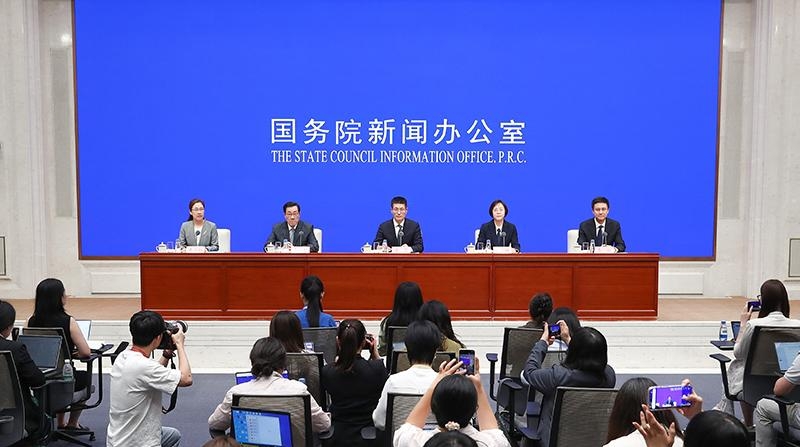
Speakers:
Mr. Lu Lei, deputy governor of the People's Bank of China (PBOC)
Ms. Cong Lin, vice minister of the National Financial Regulatory Administration (NFRA)
Mr. Li Chao, vice chairman of the China Securities Regulatory Commission (CSRC)
Mr. Li Bin, spokesperson and deputy administrator of the State Administration of Foreign Exchange (SAFE)
Chairperson:
Ms. Shou Xiaoli, director general of the Press Bureau of the State Council Information Office (SCIO) and spokesperson of the SCIO
Date:
Sept. 10, 2026
Shou Xiaoli:
Ladies and gentlemen, good afternoon. Welcome to this press conference held by the State Council Information Office (SCIO). Today's briefing is part of a series of press conferences themed "Embarking on the 15th Five-Year Plan." Today, we are pleased to have with us Mr. Lu Lei, deputy governor of the People's Bank of China (PBOC); Ms. Cong Lin, vice minister of the National Financial Regulatory Administration (NFRA); Mr. Li Chao, vice chairman of the China Securities Regulatory Commission (CSRC); and Mr. Li Bin, spokesperson and deputy administrator of the State Administration of Foreign Exchange (SAFE). They will brief you on implementing the 15th Five-Year Plan in the financial sector and building China into a financial powerhouse, and answer your questions. Now, I'll give the floor to Mr. Lu for his introduction.
Lu Lei:
Friends from the media, good afternoon. Thank you all for your long-standing interest in and coverage of China's financial sector and the work of the PBOC. During the 14th Five-Year Plan period (2021-2025), under the strong leadership of the Central Committee of the Communist Party of China (CPC) with Comrade Xi Jinping at its core, the financial sector made a series of major advances in reform and development. The Party's leadership and Party building in the financial sector have been comprehensively strengthened, the sector's support for the real economy has improved in terms of both quality and efficiency, and reform and opening up have continued to advance. Risks in key areas have been properly addressed, gaps in financial regulation have been closed at a faster pace, financial opening up has continued to advance, and the sector's capacity to serve broader national priorities has been significantly enhanced.
China's economic and financial environment faces profound and complex changes during the 15th Five-Year Plan period (2026-2030). General Secretary Xi Jinping's important remarks on financial work have pointed the way for building China into a financial powerhouse and for financial reform and development. The 15th Five-Year Plan for Building China into a Financial Powerhouse has been officially released. Under the overall coordination of the Central Financial Commission, the plan was formulated by the Office of the Central Financial Commission together with relevant financial authorities and institutions, to fully implement the guiding principles of the 20th CPC National Congress and all plenary sessions of the 20th CPC Central Committee, carry out the decisions and arrangements of the Central Financial Work Conference, and meet the requirements of the outline of the 15th Five-Year Plan. The document serves as the overall strategy and specific plan for financial work during the 15th Five-Year Plan period.
It adheres to the general principle of seeking progress while maintaining stability and prioritizes risk prevention, stronger financial supervision and high-quality development. It emphasizes achieving high-quality development of the financial sector while serving high-quality socio-economic development, with effective financial risk prevention and resolution and stronger financial supervision as the foundation.
The overall goal is to establish the overarching framework of a modern financial system with Chinese characteristics by 2030. The financial regulation policies will be well coordinated and effective, the financial system will have a sound and optimized structure, financial supervision will be rigorous and robust, and financial risk prevention and control will be targeted and efficient. The quality and efficiency of financial support for socio-economic development will continue to improve, and a comprehensive legal framework for the financial sector will be in place. High-standard financial opening up will expand steadily, and the financial sector's international influence and competitiveness will continue to grow. By 2035, a modern financial system with Chinese characteristics that is highly adaptable, competitive and inclusive will be largely established, laying a solid foundation for building China into a financial powerhouse.
To accelerate the development of a modern financial system with Chinese characteristics, the plan sets out a comprehensive set of priority tasks for building China into a strong financial powerhouse during the 15th Five-Year Plan period. These include improving the financial macro-regulation system, comprehensively strengthening financial supervision, effectively preventing and defusing financial risks, taking proactive and effective measures to support the real economy, promoting high-quality development of the financial sector, and expanding high-standard financial opening up.
To effectively implement the outline of the 15th Five-Year Plan and the 15th Five-Year Plan for Building China into a Financial Powerhouse, the PBOC recently formulated and issued its reform and development plan for the 15th Five-Year Plan period, along with nine supporting action plans in related fields. These plans are anchored to the six core elements of a financial powerhouse identified by General Secretary Xi Jinping, aimed at promoting the building of a financial powerhouse and serving high-quality economic development through the efficient performance of the central bank's duties. Now let me briefly introduce the main points.
First, we will focus on the objectives and improve the framework. Monetary and financial stability have always been the main objectives of the central bank's work. That requires an efficient and stable framework, namely a dual-pillar policy framework consisting of a monetary policy system and a macro-prudential management system. We will build a sound and robust monetary policy system and a comprehensive macro-prudential management system. We must effectively implement counter-cyclical and cross-cyclical adjustments, and ensure that aggregate financing and money supply rise in step with projected economic growth and CPI levels. We should optimize the mechanism for market-based interest rate formation, regulation and transmission. We should give full play to the decisive role of the market in exchange rate formation, enhance the flexibility of the RMB exchange rate, and keep the RMB exchange rate broadly stable at an adaptive, balanced level. We should improve monetary policy communication and expectations management. We will expand the central bank's macro-prudential and financial stability functions. We will broaden the scope of macro-prudential management, diversify its toolkit, and strengthen the monitoring and assessment mechanism. We will also enhance the financial stability guarantee system and effectively resolve financial risks in key areas.
Second, we will focus on the fundamental purpose of serving the real economy, improve the financial policy system, and provide targeted and effective support for major strategies, key areas and weak links. We will promote the transition from old to new growth drivers and enhance the quality and efficiency of financial services for the real economy. We should advance work in the five major areas of finance and improve the adaptability of financial products and services. We should build a sci-tech finance system that is compatible with technological innovation, develop a high-quality sci-tech board for the bond market, and improve the quality and efficiency of financial support for green development and low-carbon transformation. We should continuously improve the inclusive finance system, improve the pension finance system, accelerate the development of digital finance, and strengthen financial support to boost and expand consumption. As an institution responsible for macroeconomic management, the central bank should focus on the goals of economic growth and price stability, continue to improve its policy framework, and support the transformation of the real economy.
Third, we will focus on improving the financial structure, continue to develop an open, inclusive, dynamic and resilient modern financial market, and promote the optimization of the financing structure. We will improve the diversified, multi-tiered financial market system, further foster new business forms and models in the financial markets, enhance the inclusiveness of financial markets, increase the proportion of direct financing and better leverage the role of financial markets in promoting the development of new quality productive forces. We will continue to deepen market-oriented reforms and further enhance the role of the financial market in price discovery and resource allocation. We will strengthen the institutional framework of the financial market, improve the macro-prudential management framework and regulatory system, and maintain the steady and healthy operation of the financial market.
Fourth, we will focus on promoting reform and development through opening up, and advance high-standard opening up of the financial sector. We will promote the internationalization of the RMB and expand its role in international trade and investment and financing. We will deepen the two-way opening up of financial markets and strengthen cross-border connectivity among financial infrastructures. We will develop the offshore RMB markets and expand the supply of offshore RMB liquidity. We will improve the multi-tiered and wide-reaching cross-border RMB payment system. We will accelerate the development of Shanghai as an international financial center, consolidate and enhance Hong Kong's status as an international financial center, and enhance the international attractiveness and influence of these financial centers. We will actively participate in and promote global financial governance reform. We will balance openness and security, and safeguard financial stability.
Fifth, we will comprehensively strengthen the foundation for the central bank to perform its duties and continuously optimize the financial infrastructure and central bank service system. We will strengthen the top-level design of financial infrastructure, promote the development of a financial infrastructure system that is rationally laid out, effectively governed, advanced, reliable and resilient, and enhance the risk management capabilities, governance and technological support capabilities. We will improve the quality and efficiency of central bank financial services, improve financial statistics, payment, treasury and cash service systems, steadily advance the development of the digital RMB, promote the high-quality development of the credit reporting industry, and strengthen anti-money laundering supervision. We will comprehensively advance the development of a law-based and digital central bank. We will optimize the central bank's own services and infrastructure to solidify the foundation for its work in building a financial powerhouse.
During the 15th Five-Year Plan period, the PBOC will make every effort to ensure the implementation of the decisions and arrangements of the CPC Central Committee and the key tasks and measures set out in plans at all levels, accelerate the building of a financial powerhouse and support high-quality economic development.
That concludes my introduction. I'm happy to take any questions you might have. Thank you.
Shou Xiaoli:
Thank you, Mr. Lu. Next, I will give the floor to Ms. Cong for her introduction.
Cong Lin:
Thank you, Ms. Shou. Friends from the media, good afternoon. First, on behalf of the NFRA, I would like to extend my sincere gratitude to the media for your long-standing interest in, support for and coverage of our financial regulatory work.
During the 14th Five-Year Plan period, we consistently followed the guidance of Xi Jinping Thought on Socialism with Chinese Characteristics for a New Era, fully upheld the political and people-centered nature of financial work, made positive contributions to building China into a financial powerhouse, and successfully completed all the goals and tasks set out in the 14th Five-Year Plan. First, the sector has made solid progress in high-quality development. The financial sector has maintained stable operations overall, with major regulatory indicators remaining within a healthy range. By the end of 2025, the provision coverage ratio of commercial banks stood at 205.21%, and their capital adequacy ratio was 15.46%. The average comprehensive solvency adequacy ratio of insurance companies was 181.1%. As you all have noticed, last year, major state-owned banks replenished their capital by 520 billion yuan, and recently eight central financial enterprises increased their capital by another 360 billion yuan. This will further enhance the ability of large state-owned financial institutions to operate soundly, withstand risks and serve the real economy. Second, the quality and efficiency of financial services have been continuously improved. The banking and insurance sectors have provided more than 170 trillion yuan in new financing support to the real economy through various channels such as credit, bonds and equity. The insurance industry has paid out a total of 9.7 trillion yuan in claims, an increase of 65% compared to the 13th Five-Year Plan period (2016-2020). Third, risks in key areas were addressed in an orderly manner. Significant progress has been made in efforts to prevent and resolve financial risks. The number of high-risk local small- and medium-sized financial institutions has been significantly reduced from its peak, and the bottom line of preventing systemic financial risks has been firmly upheld. Fourth, the effectiveness of financial regulation has continued to improve. Significant progress has been made in strengthening the rule of law in the financial sector, and effectiveness of law enforcement has been significantly improved. Efforts to coordinate financial consumer protection have been steadily advanced. Mechanisms for preventing and combating illegal activities in the financial sector have been established at the provincial, municipal and county levels.
The 15th Five-Year Plan period is critical as we work to reinforce the foundations and push ahead on all fronts toward the basic realization of socialist modernization. It is also an important stage in building China into a financial powerhouse. Under the strong leadership of the CPC Central Committee and the State Council, we will unswervingly follow the path of financial development with Chinese characteristics, pursue a holistic approach to preventing risks, strengthening regulation and promoting high-quality development, and strive to usher in a new phase of financial regulation. Let me elaborate on three aspects for our friends from the media:
To prevent risks, we will earnestly implement the fundamental principles of maintaining overall stability, ensuring coordination, adopting category-based policies and defusing risks through targeted efforts, and steadily advance risk prevention and mitigation in key areas. We will prevent and defuse risks in local small- and medium-sized financial institutions in a robust, orderly and effective manner, and firmly hold the bottom line of preventing major financial risks. We will press ahead with efforts to reduce the number and improve the quality of local small- and medium-sized financial institutions, and optimize their layout. Furthermore, we will step up efforts to prevent and combat illegal financial activities, and better protect the people's savings.
To improve regulation, we will comprehensively reinforce the regulation of institutions, conduct, and functions, and bolster look-through supervision and ongoing supervision, ensuring our enforcement is sharp, stringent and uncompromising. Focusing on key individuals, major matters and critical practices, we will step up efforts to advance the rule of law in the financial sector. We will improve the classified and tiered regulatory framework and steadily advance differentiated regulation. We will strengthen technology empowerment and effectively enhance our look-through supervision capabilities. Moreover, we will guide financial institutions to accelerate the transformation of their development models and strengthen their capacity for sustainable development.
To promote high-quality development, we will work to ensure that financial institutions advance the development of technology finance, green finance, inclusive finance, pension finance and digital finance, and further strengthen financial services and support for major strategies, key areas and weak links. We will increase financial support for areas capable of boosting consumption, expanding investment, stabilizing enterprises, stabilizing employment, as well as advancing technological innovation. We will ensure financing support for major national strategies and security capacity-building projects in key areas, as well as large-scale equipment upgrades and consumer goods trade-in programs. We will support the construction of major projects during the 15th Five-Year Plan period. We will also continue to improve comprehensive financial services to support efforts to stabilize foreign trade.
That concludes my introduction. Thank you.
Shou Xiaoli:
Thank you, Ms. Cong, for your introduction. Now, I would like to invite Mr. Li Chao to provide his introduction.
Li Chao:
Good afternoon, friends from the media. First, I would like to express my sincere thanks for your longstanding interest in and support for China's capital market reform and development, as well as the work of the CSRC. The CPC Central Committee and the State Council attach great importance to the capital market. Looking at successive five-year plans, we can see that the arrangements for capital market development have become increasingly extensive and substantial. The outline of the 15th Five-Year Plan has made major new arrangements to make capital market institutions more inclusive and adaptive, while enhancing capital market functions to achieve better coordination between investment and financing. The CSRC has earnestly implemented the requirements of the CPC Central Committee, gathering extensive input from all sides and conducting in-depth research. Our overall approach to capital market work during the 15th Five-Year Plan period is to focus closely on the overarching goal of building a capital market that is safe, well-regulated, transparent, open, dynamic and resilient. To this end, we will continue to advance the implementation of the new nine-point guideline and the "1+N" capital market policy framework, take the continued deepening of comprehensive investment and financing reform as the driving force, make greater institutional inclusiveness and adaptability our guiding principles, and strengthen law-based, stringent regulation as a safeguard. We will accelerate a new round of capital market reform and opening up. Our goal is that by 2030, marking the 40th anniversary of the establishment of China's capital market, a new pattern of capital market high-quality development will be in place, with its overall strength and international competitiveness significantly enhanced. I would like to introduce the work with a focus on eight key areas:
First, we will further enhance the inclusiveness and adaptability of capital market institutions. We will proactively adapt to new trends in global sci-tech innovation and industrial transformation, stepping up our efforts across five priority aspects encompassing technology finance, green finance, inclusive finance, pension finance and digital finance. We will significantly improve the quality and effectiveness of capital market services in supporting the development of new quality productive forces. Additionally, we will refine China's issuance and listing systems, and support the growth and development of high-quality companies of different types and across different industries, including emerging industries, future industries, traditional industries undergoing transformation and upgrading, modern services and new forms of consumption.
Second, we will further enhance the intrinsic stability of the capital market. Drawing on what we have learned over the past few years, we will continue to reinforce the mechanisms that keep the market stable and expand the forces that help stabilize the market. We will further broaden the sources, channels and entry pathways for medium- and long-term capital, and improve the market mechanisms and ecosystem to encourage long-term capital to make long-term investments. At the same time, we will step up risk monitoring, early warnings and comprehensive assessments to ensure smooth and stable market operations.
Third, we will tighten regulation and enhance investor protection. We will follow the principle of a people-centered approach in the financial sector, and step up efforts in the five major areas of supervision. Our focus will remain on high-precision enforcement against major offenses like fraudulent issuance, financial fraud, market manipulation and insider trading to create a stronger deterrent. Furthermore, we will speed up refining the capital market's legal framework system and investor protection mechanisms so that investors can genuinely experience a fair and just market.
Fourth, we will further improve the multi-tiered capital market system. To meet the diverse and full-lifecycle financing needs of the real economy, we will guide market segments and trading venues to better define their positioning and enhance their functions. We will improve our diversified equity financing system, cultivate a multi-tiered bond market, and make better use of asset securitization and Real Estate Investment Trusts (REITs) to unlock value from existing assets. In addition, we will optimize product offerings in the futures market and enhance China's influence over commodity pricing.
Fifth, we will further improve the quality and investment value of listed companies. High-quality development of the capital market cannot be achieved without a group of high-quality listed companies. We will make greater efforts to unleash the vitality of reforms in mergers and acquisitions (M&A), and support listed companies in their transformation and upgrading to grow stronger and more competitive. We will improve corporate governance and standardized operations, and guide listed companies to enhance their value through equity incentives, dividends and share buybacks. We will strictly implement and continuously improve the delisting system.
Sixth, we will further accelerate the development of first-class investment banks and investment institutions. We will place greater emphasis on the functional role of industry institutions and encourage them to focus on their core businesses, improve governance and pursue differentiated development. We will also encourage them to enhance their overall strength and professional service capabilities, and actively cultivate a positive industry and investment culture.
Seventh, we will further build safe and efficient financial infrastructure. We will accelerate the development of world-class exchanges and comprehensively enhance their overall strength and global competitiveness. We will also improve the security and technological sophistication of infrastructure such as trading and settlement systems.
Eighth, we will further advance high-level opening up. We will continue to promote reform and development through opening up, continuously improve cross-border investment and financing facilitation, optimize institutional mechanisms such as the qualified foreign investor and market connectivity programs, and support enterprises in making good use of both domestic and overseas markets and resources. We will actively participate in global financial governance, and strengthen regulatory capacity building amid financial market opening up.
This year marks the start of the 15th Five-Year Plan. The CSRC has worked to make sure that officials have a correct understanding of what it means to perform well and act accordingly, kept a rigorous grip on its work from the outset, earnestly implemented the outline of the 15th Five-Year Plan, and advanced long-term planning and immediate action in a coordinated manner. Market operations have remained generally stable and active. The whole-chain regulatory system has kept improving, comprehensive investment and financing reforms have achieved new breakthroughs, the multi-tiered market is functioning effectively, and the capital market has made a solid start. Going forward, under the strong leadership of the CPC Central Committee and the State Council, we will stay focused on our core priorities of preventing risks, strengthening supervision and promoting high-quality development. We will do our own work well and, step by step, turn the blueprint for the capital market laid out in the outline of the 15th Five-Year Plan into reality, contributing to building a financial powerhouse and advancing Chinese modernization. Thank you.
Shou Xiaoli:
Thank you for your introduction, Mr. Li Chao. Next, I will give the floor to Mr. Li Bin.
Li Bin:
Thank you, Ms. Shou. Hello, everyone. I would like to thank you for your long-standing interest in and support for the administration of foreign exchange. Next, I will briefly outline our main ideas and considerations for implementing the 15th Five-Year Plan and ensuring sound foreign exchange management.
Looking back on the 14th Five-Year Plan period, under the strong leadership of the CPC Central Committee, foreign exchange management adhered to the principle of balancing development and security. We made significant progress in foreign exchange reform, significantly improved the quality and efficiency of our services to the real economy, and continuously strengthened our capacity for supervision and risk prevention. We also effectively responded to external risks and challenges and kept China's balance of payments basically in equilibrium. In 2025, cross-border receipts and payments reached $15.6 trillion, up 80% from 2020, while foreign exchange market trading volume reached $42.6 trillion, up 42%. The resilience and vitality of the foreign exchange market continued to strengthen, and China's foreign exchange reserves remained the largest in the world.
Looking ahead to the 15th Five-Year Plan period, we will firmly promote high-quality development and high-level opening up, guided by a service-oriented, open and security-conscious approach. We will comprehensively deepen foreign exchange management reform, enhance our services, and build a foreign exchange management system featuring greater convenience, openness, security and smarter governance. This will take the building of a financial powerhouse and high-level opening up to a new level.
Greater convenience is about enabling compliant and trustworthy business entities to handle foreign exchange business more efficiently and conveniently. We will vigorously advance reform of how banks conduct foreign exchange business and keep improving a facilitation policy system built on the principles of greater convenience for more trustworthy entities and priority access for compliant ones. More enterprises with good credit records will be able to process foreign exchange transactions on instructions, with no need for document checks. Building on improvements to existing facilitation policies, we will also study and implement more targeted support policies. These will focus on the five major areas of finance and on key areas such as new forms of trade and multinational corporations. We will also better align RMB and foreign currency policies, so that businesses can process the same types of cross-border RMB and foreign exchange transactions under a single set of rules.
Greater openness is about expanding the scope and raising the level of opening up in the foreign exchange sector. Direct investment, portfolio investment and cross-border financing are the main components of the capital account. During the 15th Five-Year Plan period, we will continue to steadily advance foreign exchange management reforms in these areas and enhance the stability and predictability of the system. We will continue to vigorously support the development of international financial centers as well as the opening up and growth of key areas. We will focus on raising the level of capital account opening up, and further strengthening its coordination and alignment with China's foreign-related economic development and the internationalization of the RMB.
Greater security is about making the prevention and control of risks in cross-border capital flows more robust and effective. We will ensure both the vitality and effective regulation in the foreign exchange market, and continue to improve the two-pronged regulatory framework that combines macro-prudential management with micro-level regulation. We will continue to improve macro-prudential regulation of cross-border capital flows, guard against systemic risks that may arise from large inflows and outflows of funds, and keep the foreign exchange market running smoothly. We will strengthen supervision over foreign exchange transactions to ensure that they are genuine and compliant, and crack down hard on illegal and non-compliant activities such as fraudulent transactions and underground banking. We will continue to improve the operation and management of foreign exchange reserves with Chinese characteristics and ensure the safety, liquidity, and value preservation and appreciation of foreign exchange reserve assets.
Smarter governance means improving the foreign exchange governance system to ensure more scientific decision-making and more effective implementation. We will continue to build a more systematic and complete legal framework for foreign exchange management and advance the revision of the foreign exchange administration regulations. We will reinforce policy transmission and effectiveness tracking. We will also improve our three evaluation systems, which assess foreign exchange policy, the foreign exchange ecosystem, and whether banks run their foreign exchange business in a compliant and prudent way. The aim is to achieve dynamic optimization covering policy formulation, evaluation and improvement. We will focus on building a modern balance of payments statistical system. We will also work to boost the digital and intelligent capabilities of foreign exchange management, leveraging technology to manage risks while delivering faster, more efficient foreign exchange services.
During the 15th Five-Year Plan period, SAFE will balance high-level opening up with high-level security, align systematic planning with orderly implementation, and pool its efforts and take concrete steps to help build a financial powerhouse and advance high-level opening up. That concludes my introduction. Thank you.
Shou Xiaoli:
Thank you, Mr. Li, for your introduction. We will now move to the Q&A session. Please identify the media outlet you represent before asking your questions.


 京公网安备 11010802027341号