 Share:


South China Morning Post:
The RMB is already being used widely in trade settlement, but there is still room for further expansion in its use in international investment, financing and reserve assets. What are the policy considerations for promoting the internationalization of the RMB in the next stage? Thank you.
Lu Lei:
I'll take this question. Thank you very much for your interest in these issues. Overall, the internationalization of the RMB is a continuous and steady process, and an irreversible trend. In terms of specific timing, in recent years, the international monetary system has been diversifying at an accelerated pace, and business entities have shown increased demand for using the RMB. The PBOC has adapted to changes in the international situation and market demand, promoting the internationalization of the RMB, and steadily enhancing the RMB's international monetary function and international status. On a comprehensive basis, the RMB has become China's largest settlement currency for cross-border receipts and payments, the world's second-largest trade finance currency, and the third-largest payment currency. It also ranks third in weighting in the International Monetary Fund's Special Drawing Rights (SDR) basket.
However, we should note that the internationalization of any currency, including the RMB, is a multi-dimensional and comprehensive issue. When assessing the level of RMB internationalization, it is necessary to consider its use (i.e., payments and receipts), holding (i.e., the attractiveness of assets denominated in this currency), circulation (i.e., whether there is a complete payment and settlement system), offshore presence (i.e., whether there is an overseas circulation system alongside the onshore system), and cooperation between central banks (i.e., whether liquidity safety mechanisms have been established). I will briefly introduce those dimensions.
First, the scale of cross-border RMB payments and receipts has steadily increased, enhancing its efficiency in serving the real economy. From January to July this year, the total amount of RMB cross-border receipts and payments exceeded 50 trillion yuan, including over 9 trillion yuan in goods trade, accounting for 30% of the total amount of RMB and foreign currency cross-border receipts and payments during the period, which is the best level in history.
Second, with the steady opening up of the financial market, the global appeal of RMB assets has increased. Currently, overseas entities hold over 11 trillion yuan of RMB financial assets in China. Central banks or monetary authorities in more than 80 countries and regions have included the RMB in their foreign exchange reserves, and RMB bonds and stocks have been included in major global asset trading indices. The cumulative issuance of Panda bonds has exceeded 1.3 trillion yuan, with issuers covering 26 countries and regions across five continents.
Third, the global RMB payment and clearing network is becoming increasingly advanced. A multi-channel and widely covered RMB cross-border payment system has been basically established. The RMB clearing network is also expanding rapidly, with 42 banks authorized as clearing banks in 36 countries and regions, covering major international financial centers.
Fourth, the offshore RMB market is increasing in depth, and the channels for RMB circulation overseas are becoming smoother. RMB deposits in major offshore markets amounted to approximately 1.8 trillion yuan, offshore RMB loans exceeded 1.2 trillion yuan, and offshore RMB bonds reached 2.5 trillion yuan.
Furthermore, international monetary and financial cooperation has been comprehensively deepened. The PBOC has signed 33 effective bilateral currency swap agreements with foreign central banks or monetary authorities, totaling 4.6 trillion yuan, which have become an important part of the global financial safety net.
During the 15th Five-Year Plan period, the PBOC will focus on serving the real economy and facilitating trade and investment, respond to market demands, and create a better environment for domestic and foreign entities to hold and use RMB. Efforts will be focused on the following areas.
First, we will strengthen international monetary and financial cooperation. We will actively advance the reform and improvement of global financial governance and expand the use of local currencies in bilateral settlements. We will also expand the coverage of currency swap agreements, and support foreign central banks in launching regular policy tools to use funds obtained through RMB swap arrangements to support trade and investment.
Second, we will optimize the policy system for cross-border RMB use. We will introduce more high-quality policies to make the RMB easier to use in cross-border trade, investment and financing, and promote its wider use in these areas.
Third, we will deepen the high-level opening up of the financial market. We will promote the alignment of market rules with international standards, expand the interconnectivity of financial markets, optimize mechanisms such as the Shanghai-Hong Kong Stock Connect, Shenzhen-Hong Kong Stock Connect, Bond Connect, and Swap Connect, and promote the transition toward full opening up of the onshore market. We will accelerate the development of Shanghai as an international financial center and foster its role as a center for RMB asset allocation and risk management.
Fourth, we will continue to improve the construction of the RMB cross-border payment system. We will optimize the functions and services of the Cross-border Interbank Payment System (CIPS), promote interconnectivity and interoperability, such as in fast payment systems and QR code payments, and actively promote the use of digital RMB in cross-border scenarios.
Fifth, we will continue to support the healthy development of the offshore RMB market. We will optimize the layout of RMB clearing banks, improve the multi-tiered and cross-term liquidity supply mechanism, and maintain sufficient and stable RMB liquidity in the offshore market. We will also regularly issue treasury bonds and central bank bills to enrich the pool of high-grade RMB assets. In terms of key regions, we will promote the development of Hong Kong as an offshore RMB hub, and support the differentiated development of offshore RMB markets in London, Singapore and Dubai.
That's all from me. Thank you.
Shou Xiaoli:
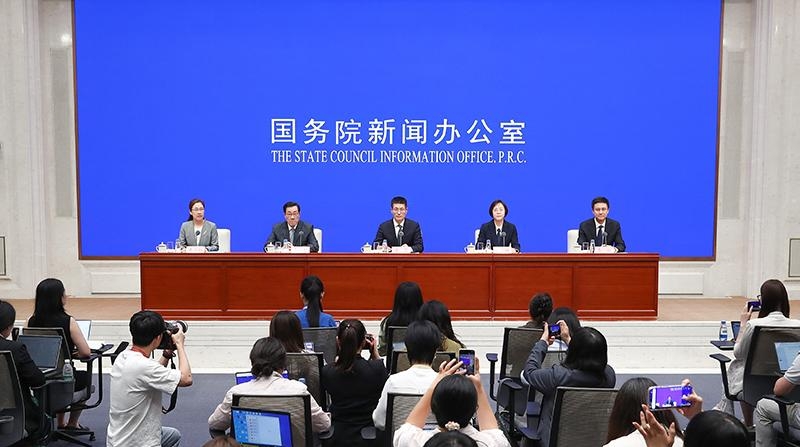
Thank you to all the speakers and friends from the media. Today's briefing is hereby concluded. Goodbye.
Translated and edited by Liu Jianing, Mi Xingang, Liu Caiyi, Yang Chuanli, Yang Xi, You Jiaxin, Xu Kailin, Wang Mengru, Yan Xiaoqing, Zhang Junmian, Ma Yujia, Gong Yingchun, Huang Shan, Li Huiru, Zhou Jing, Liu Qiang, Yuan Fang, Fan Dongni, Zhang Lulu, David Ball, Jay Birbeck, Wang Qian, and Guo Xiaohong. In case of any discrepancy between the English and Chinese texts, the Chinese version is deemed to prevail.


 京公网安备 11010802027341号