Museum tells past stories of overseas Chinese
 0 Comments


 |
|
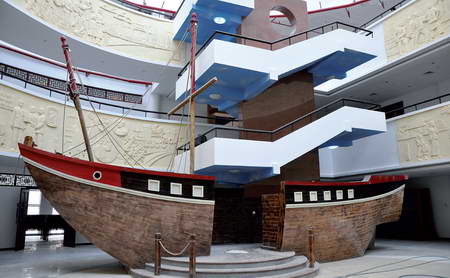
The exhibition hall with a model boat on display. [Global Times] |
After seven years of construction and a further seven years of being deserted, the Guangdong Provincial Overseas Chinese Museum was finally declared open last week for a trial run, with more than 1,000 pieces of cultural relics from overseas Chinese on display.
With a total investment of more than 90 million yuan (US$13.18 million), the museum covers nearly 15,000 square meters, making it the largest museum in China about overseas Chinese.
The goal of the museum is to explore the experiences of overseas Chinese and track the contributions that they have made to their homeland, explained museum director Wang Minghui, at the opening ceremony Friday.
For many who sought their fortune overseas from the 17th to 19th centuries, the experience was often painful. They traveled to every corner of the globe, only to find themselves working in large farms or factories to earn a living.
There is even a saying that "under every railroad tie of the Central Pacific Railroad there is a Chinese worker buried."
The grand display in Guangdong Provincial Overseas Chinese Museum follows this period of history, showcasing a wide range of odds and ends that the intrepid travelers once used during their overseas expeditions.
Exhibited are safety lamps used as they worked as miners in America and several paper contracts they signed to sell themselves to farm or factory owners. Among the artifacts, 17 pieces of ceramic plates in various shapes, such as a butterfly and cicada, play witness to Chinese workers' lives in the Southern Seas, where many poor Chinese young people from the southern provinces such as Guangdong and Fujian, flooded to in the mid and late 19th century.
These kinds of ceramic plates were used as a special kind of currency that farm or factory owners often paid to the Chinese workers and were only circulated within their work places, according to Wang.
"It was actually a tool to exploit the Chinese workers, for they had to spend their 'money' in stores opened by their employers and they couldn't send their payment back to their homes in China as they were only ceramic plates not money, "he explained.


Comments