Floating like a butterfly
 0 Comments


Like many other young girls who love singing and dancing, Zhou Peng was excited to appear on television when she won a national singing competition in 1999 at 16. Then she released an album that sold well and became known as "China's first dance music singer".
But instead of following along the usual route of pop stardom she paused and re-branded herself. Like the caterpillar becomes a butterfly, Zhou transformed herself into Sa Dingding, a stage moniker that comes from her mother's Mongolian surname, and a childhood nickname.
|
|
|
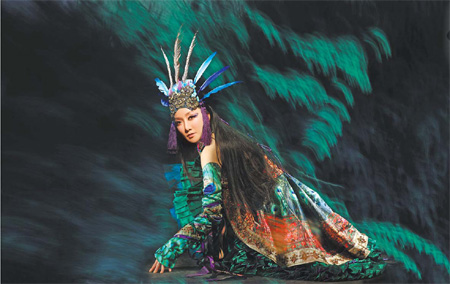
Chinese folk singer Sa Dingding. [File photo] |
"The albums and dances were childish. I was just a singer then. In a short time I became a star and earned some money. But I wanted to create and produce my own music, something special that allowed me to express myself fully," she says.
She drew on her childhood experiences as a nomad on the grasslands of Inner Mongolia, with her grandma, where she learned how to sing and play the guzheng (a zither like six-stringed pluck instrument) and the horse-headed fiddle (Mongolian bowed instrument). Today, she not only sings in Mandarin and Mongolian but also Tibetan, Sanskrit and a language of her own invention - "Zi Yu".
Her exotic costumes, on and off stage, mysterious music videos and songs, which incorporate Buddhist mantras, traditional Chinese instruments and electronica, got her nicknamed the "Asian Bjork" by Western media.
Her album, Alive, which mixed traditional Chinese tones and Buddhist mantras with electronica, won her a BBC Radio 3 Award for World Music in 2008. It sold more than 2 million copies in Asian countries and was also released in the United States.
Sa recently previewed her new album, Harmony, which absorbs influences from ethnic group music and folk tales in Yunnan province.


Comments