Passing it forward to young musicians
 0 Comment(s)
 Print
Print E-mail China Daily, April 8, 2013


|
|
|
Oboist Wang Liang [Photo/China Daily] |
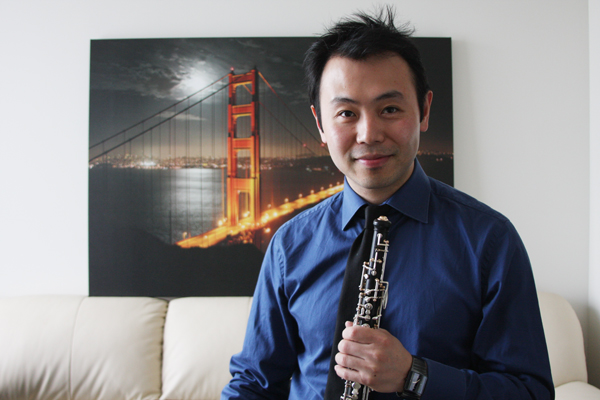
When he was just 7 years old, Wang Liang fell in love with the sound of the oboe after watching an uncle perform Tchaikovsky's Swan Lake in China. Ever since, Wang has pursued his dreams in music, and in 2007, 20 years after being enamored by the oboe, he became the first Chinese-born principal oboist of the New York Philharmonic.
Wang is still with the New York Philharmonic, which was established in 1842 and has performed in some 15,000 concerts, more than any orchestra in the world.
As a foreign-born artist living his dream in New York City, Wang is ready to pass on his knowledge to inspire young Chinese music lovers to realize their own dreams.
At the end of 2012, the New York Philharmonic and the Shanghai Symphony Orchestra established a four-year partnership in collaboration with Columbia Artists Music LLC to establish the Orchestral Academy in Shanghai, which will enroll 30 students annually beginning in the fall of 2014.
It also includes annual performances by the philharmonic in Shanghai through the 2017-18 season.
"It will be an overture for running the orchestra institute for highly selective young musicians in China," Wang says.
The agreement was reached through the efforts of many visionaries from the United States and China, including philharmonic music director Alan Gilbert, chairman Gary Parr and Shanghai Symphony Orchestra music director Yu Long.
At the invitation of the Shanghai government, Wang, the Shanghai Symphony Orchestra, the Shanghai Conservatory of Music as well as artistic administrator Edward Yim and principal horn Phil Myers attended an April 7 meeting to lay out detailed plans for the academy.
The school will address a major need in Asia: specialized training of orchestra musicians.
The philharmonic musicians will provide high-level training and instruction to students at the Shanghai Conservatory through three weeklong sessions each season, plus one session during each of the philharmonic's resident performances.
The first New York Philharmonic performance in Shanghai will take place in the summer of 2015.
"We will be in Shanghai to exchange ideas, performances and lectures on behalf of the philharmonic. We will help choose and train 30 young musicians, mostly post-graduates who we believe will have great potential to become great artists," Wang says. "I believe it will gradually raise the level of Chinese orchestras."
Wang's own music career started modestly. As a 14-year-old trying to select an oboe, he met a talent scout who listened to him play and then offered him an opportunity to study in the US. After an impressive audition, Wang enrolled in the Idyllwild Arts Academy in Southern California on a full scholarship.
The principal oboe is considered one of the most fundamental instruments in the orchestra. Wang, 33, says he plans to stay at the New York Philharmonic for at least another 20 years.
Although Wang moved to the US more than 17 years ago, he says he sees himself first and foremost as Chinese.
"The Chinese element is always deeply embedded in me and it's not something you choose. Now that I'm a Chinese-American, I'm also given every opportunity there to live the dream I had."
And he believes music can cross boundaries between different cultures.
"While I'm in the US, I hope to make things happen in music between the two biggest economic powerhouses," he says. "We are so interdependent on each other in so many ways, so it'll be in our best interest to better understand each other's culture through the exchange of culture.
"Harmony is always a good thing."


Go to Forum >>0 Comment(s)