Anhui park celebrates public art
 0 Comment(s)
 Print
Print E-mail China Daily, November 20, 2013


The giant rubber ducks that recently captivated citizens of Hong Kong and Beijing have ignited a new passion for public art. Now art enthusiasts hope the love will keep burning through other channels.
|
|
|
The ongoing 3rd Liu Kaiqu Award International Sculpture Exhibition features award-winning sculptures in a newly built park in Wuhu, Anhui province. [Photo/China Daily] |
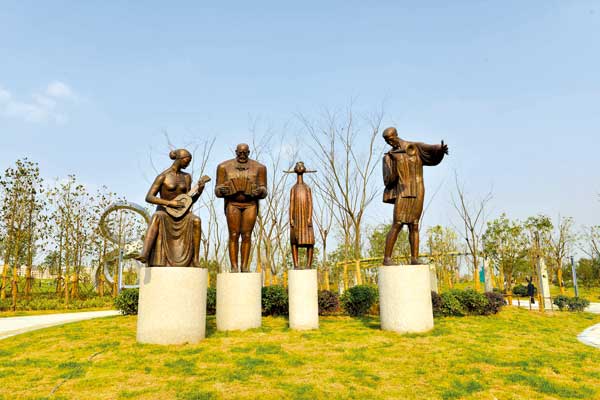
Sculpture, one of the major public art forms, is thriving thanks to China's rapid urban development, artists said at the recent opening ceremony of the 3rd Liu Kaiqu Award International Sculpture Exhibition in Wuhu city in Anhui province.
The exhibition runs year-round and is free to the public.
"As Chinese cities shift their focus from economy to culture, it means more opportunities for artists to involve in public art," says Wang Zhong, deputy director of the design school at China Central Academy of Fine Arts.
With a theme focused on culture and ecology, the ongoing exhibition showcases more than 100 pieces of sculpture that have won the Liu Kaiqu Award over the past three years. Liu Kaiqu was a pioneering Chinese sculptor and art educator in the 20th century.
The 210,000-square-meter sculpture park was previously wild mountains scattered with tombs. The municipal government spent more than 700 million yuan ($115 million) to remove the tombs to a new cemetery and transform the site into a public park. More than 3 million people have visited since 2011.
A total of 36 works won the award this year, including seven by international artists. They were selected from 2,118 pieces submitted by 506 artists from 43 countries.
The works were picked for their originality and innovation based on subjects, material and artistic forms, says Yin Shuangxi, member of the jury and a professor at the Central Academy of Fine Arts.
The gold-award winner China Dream amplifies the art of the Chinese knot in a creation of red bricks. The Chinese knot is a symbol of blessing in Chinese culture. Artist Li He used red bricks, a traditional material in Chinese building, and cut and assembled them in an extraordinary way to imitate a skyward Chinese knot.
"One of the qualities that we are looking for is the ability to convey traditional Chinese culture in a modern and universally understandable context," says Zeng Chenggang, chairman of the China Sculpture Institute, a co-sponsor of the event. The other sponsors are the China Academy of Art and the Wuhu municipal government.
The Seven Sages of the Bamboo Grove by Yu Chenxing, one of the bronze award winners, features seven bamboo chairs with lengthened legs. Bamboo is an important part of the old lifestyle south of the Yangtze River.
"Despite being an intimate part of people's memory, bamboo chairs are no longer as accessible as they were," Yu says. "Like many elements of the old lifestyle, we yearn for it but are moving in the opposite direction," Yu says.
Karin van Ommeren, a Dutch artist, won a jury award for a bronze sculpture Roots. The work echoes a trunk with tangling roots stretching into the earth, echoing the green surroundings and the theme of ecology.
It is Van Ommeren's third time taking part in a Chinese sculpture exhibition, and she says she foresees more opportunities in China.
"It's getting very hard for artists in the West because of the economic situation. Galleries are closing down," she says. "But in China, people have just started to invest in culture as part of urban development."
However, China has no effective policy to integrate public art like sculpture into the city-planning mechanism, says Wu Yixia, deputy director at the research center for landscape architecture planning at Tsinghua University.
"In Beijing, one street can be managed by five different government departments, making it very difficult to integrate public art into the city," Wu says. She is now leading a research team to create guidelines for Chinese cities to integrate public art into their city planning.


Go to Forum >>0 Comment(s)