Norman Bethune: Doctor of the Revolution
- By Thomas S. Axworthy
 0 Comment(s)
 Print
Print E-mail China Today, June 14, 2017


Norman Bethune is the best known Canadian in the world, according to Adrienne Clarkson, a former governor general of Canada and herself of Chinese descent. This is so because Bethune is a hero of China’s revolutionary era, immortalized by Mao Zedong in his December 21, 1939 essay “In Memory of Norman Bethune.” Bethune had died six weeks previously in Huangshikou, Hebei Province, after cutting his finger accidentally during an operation. The wound became infected and he died of septicemia, age 49.
|
|
|
Dr. Norman Bethune, assisted by Henning Sorensen, performing a transfusion during the Spanish Civil War. Photo courtesy of Geza Karpathi / Library and Archives Canada / C-067451 |
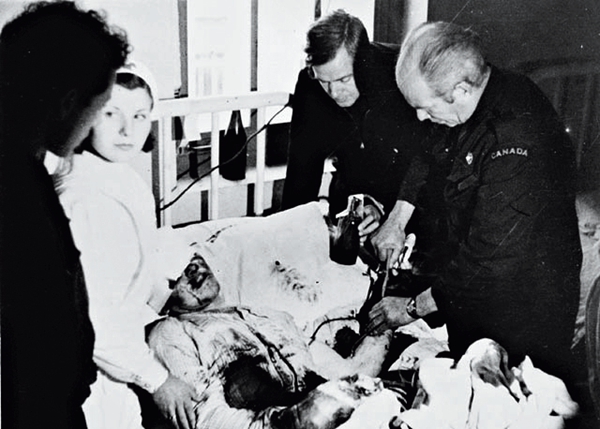
Mao wrote of Bethune, “He made light of traveling thousands of miles to help us in our war of resistance against Japan. He arrived in Yan’an, in the spring of last year, went to work in the Wutai Mountain and to our great sorrow died a martyr, at his post. What kind of spirit is this that makes a foreigner selflessly adopt the cause of the Chinese people’s liberation as his own?” Mao further instructed that “we must all learn the spirit of absolute selflessness from him.” Today we should ask the same question as Mao Zedong in 1939.
What can we learn from Norman Bethune’s example and thoughts to help China and the world cope with the problems of 2017?
Dedicated Doctor and Internationalist
Bethune was born in 1890 in Gravenhurst, Ontario, Canada. He was the son of Christian missionaries and was named after his grandfather, Norman, the founder of the Upper Canada School of Medicine. Bethune rejected the theology of his parents, but not their crusading zeal. As a young man he put himself through university by working as a lumberjack in northern Ontario during the day and in the evenings he helped immigrant laborers learn English as a member of Frontier College.
In 1914, World War I broke out and Bethune suspended his medical studies at the University of Toronto to become a stretcher bearer in the Canadian Army’s No. 2 field ambulance unit. Severely wounded at the Battle of Ypes in 1915, Bethune’s experience in the war led him to emphasize the importance of treating the wounded as close to the front as possible rather than carrying them long distances back to hospitals, because so many died en route. He later put these insights to good use in Spain and China where he introduced the use of mobile blood transfusion units on the frontlines. Mobile army surgical hospital (MASH) units are now a standard feature of every army’s medical team.
After the war, Bethune earned accreditation at the Royal College of Surgeons and moved to Detroit to set up a successful private practice. Here he contracted tuberculosis, one of the most widespread and deadly diseases of the era. Bethune insisted on a new radical treatment called pneumothorax which involved artificially collapsing the diseased lung. This was a life-changing moment. Bethune became a specialist in thoracic surgery and the treatment of tuberculosis. He even sent out Christmas cards wishing everyone “Happy Pneumothorax!” By the end of the 1930s approximately half of the patients in Canadian sanatoriums underwent this procedure.
This near death experience with tuberculosis changed his life. He told friends that selfishness and avarice had ruled his life as a doctor but that “Now, in whatever time is left to me, I’m going to look around until I find something I can do for the human race, something great, and I’m going to do it before I die.” He re-dedicated his life to eradicating the “white plague” of tuberculosis which had nearly taken his own life. Tuberculosis occurred in epidemic proportions in the early years of the 20th century: 48,000 people contracted the disease every year in Canada, including my mother, who had to spend a year recovering in a sanatorium in Saskatchewan. In Canada, during this period, one out five patients admitted to a sanatorium died of the disease (in Quebec in 1925, for example, 3,000 people lost their lives to Tuberculosis).
Bethune went to Montreal, Quebec, in 1928 to practice thoracic surgery at the Royal Victoria Hospital (a major institution affiliated with McGill University) and in 1933 he became chief of pulmonary surgery at the Hospital du Sacre-Coeur, also serving as a consultant to the hospital in Sherbrooke. While in Quebec, as he studied the causes of tuberculosis which were directly related to poverty and housing quality, he became more engaged in the politics of health. He often repeated a saying from his time in the Saranac Lake sanatorium that “there is a rich man’s tuberculosis and a poor man’s tuberculosis. The rich man recovers and the poor man dies.” He campaigned publicly for hospital insurance and public investment in tuberculosis treatment, becoming one of the first doctors in Canada to advocate Medicare – but there was little response from either the medical establishment or the governments of the day. Increasingly radicalized, he joined the Communist Party of Canada in November 1935 and began signing his letters “Comrade Beth.” Soon after joining the party he volunteered to join the Loyalist government of Spain in fighting agains t the fascist insurrection and upon returning to Canada in 1938, he went to China to support Mao Zedong in the war against Japanese imperialists.


Go to Forum >>0 Comment(s)