Celebrating the Yogurt Festival
 0 Comment(s)
 Print
Print E-mail China Today, August 31, 2017


Origin and Development
The Shoton Festival originated in the middle of the 11th century as a purely religious activity.
It is said that a major taboo of Buddhism is to kill living beings. However, as the weather begins to grow warm in the summer, the trees and grass start to grow and hibernating insects wake up. As such, it's difficult to avoid killing these small creatures when the monks walk outside the monastery. Therefore, the Gelug, one of the schools of Tibetan Buddhism, stipulated that monks must stay in monasteries for studying and worship from the fourth to sixth month of the Tibetan calendar, and are only allowed to go outside at the end of the sixth month. On the day the ban is lifted, the monks go out and travel down the mountains. People make yogurt and hold banquets for the visiting monks, during which they can also appreciate Tibetan Opera performances. This marks the origin of the Shoton Festival.
|
|
|
The Sunning of the Buddha, also known as the Buddha-basking Ceremony, is the most eye-catching prelude to the Shoton Festival. |
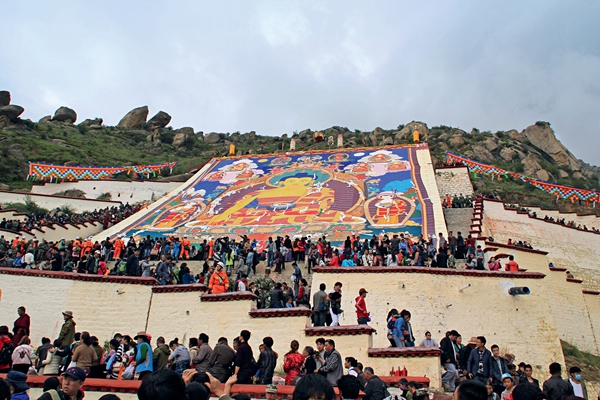
By the second half of the 17th century and the beginning of the 18th century, the theocratic system had been strengthened in Tibet, as the Qing imperial government formally granted the fifth generation of Dalai, then leader of the Gelug sect of Tibetan Buddhism, the title "Dalai Lama," and gave the fifth generation of Panchen the title "Panchen Erdeni." In 1642, the Gelug sect wielded the power and the fifth Dalai Lama became leader of the then theocratic Tibet. The Drepung Monastery where he lived became the political, religious, and cultural center of Tibet. On the last day of the sixth month of the Tibetan calendar, thousands of Buddhists swarmed into the monastery to offer yogurt to the Dalai Lama and monks, asking for blessings of longevity, good harvest, and to not go to hell after they die. The nearby troupes also put on performances such as Tibetan Opera and a yak show. As time went by, more activities have been held, making Shoton a grand festival.
According to historical records, the fifth Dalai Lama would personally watch the Tibetan Opera on the day of the festival. That same day, another spiritual leader dubbed the "iron rod" lama would take office. The "iron rod" lama was responsible for making sure every monk observed the rules and prohibitions and managed the monks in the monastery and Dratsang (a school in the monastery for monks to study Buddhist doctrine). His title was derived from the fact that he often brought an iron rod with him when inspecting the monastery.
The inclusion of the Tibetan Opera in the Shoton Festival signifies the religious event gradually evolved into cultural and entertainment activities. However, the celebration was still confined inside the monastery, with the Drepung Monastery as the center. Therefore, the festival was also called Drepung Shoton Festival.
After the white palace of the Potala Palace were finally built, the fifth Dalai Lama moved there from the Drepung Monastery. The following generations of Dalai Lama all settled in the Potala Palace, where they lived and carried out religious activities, making the palace a sacred place for lamas and Buddhists to pay homage. When celebrating the Shoton Festival, the joint performance of Tibetan Opera was first carried out in the Drepung Monastery, and then in the Potala Palace for the Dalai Lama.
|
|
|
A giant Thangka is carried by scores of lamas all the way to the big platform built along the hillside, where it is finally unfolded and displayed. |
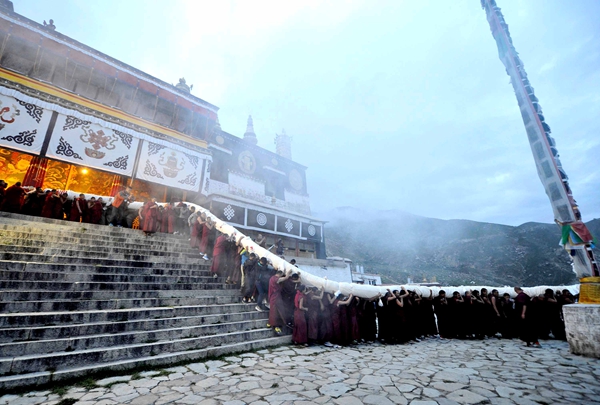
The seventh Dalai Lama suffered from many illnesses in his later years. The physicians advised him to live in Norbulingka and have a bath there with running water to preserve his health. Following this advice, he stayed in Norbulingka every summer until he passed away. By the period of the eighth Dalai Lama, the construction of Kelzang Podrang Palace was completed in Norbulingka and has gradually become the de facto summer palace for Dalai Lamas. Therefore, the main venue for celebrating the Shoton Festival was transferred to Norbulingka and ordinary people have been allowed to enter to watch Tibetan Opera performances. In this way, the Shoton Festival has gradually become a festival for everyone.
Since 1959, when the democratic reform was conducted in Tibet, the Shoton Festival celebrations have been further enriched. During the festival, residents near Lhasa City gather together to go to Norbulingka, bringing barley wines and their luggage. In addition to local Tibetan Opera troupes, other troupes from Qinghai, Gansu, Sichuan, and Yunnan all come to Lhasa to exchange experiences, with an aim to improve their performance skills. Moreover, many song and dance troupes come to put on their performances, making the event even more exciting. Businessmen also seize the opportunity to promote their goods, while still meeting the needs of visitors. The government departments and public institutions in Tibet also organize large-scale song and dance performances, as well as academic symposiums during the Shoton Festival.


Go to Forum >>0 Comment(s)