Battling educational inequity, one school at a time
- By Corey Cooper
 0 Comment(s)
 Print
Print E-mail
China.org.cn, June 17, 2011
E-mail
China.org.cn, June 17, 2011


 |
|
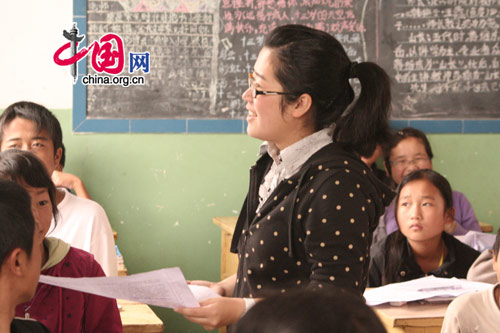
American fellows teach English classes, while Chinese fellows teach math, science, and other core subjects. The focus is on bridging the urban-rural gap on standardized test scores. [Photo courtesy of Teach For China] |
"I've been fortunate enough to have a good education, and I want to instill hope in my students that they can go beyond compulsory requirements to go to high school, and possibly college," Bruton said. "I wanted to be part of an entrepreneurial [non-profit] where I'd have a chance to help the organization innovate."
Part of Teach For China's success in impacting local communities has been in grassroots projects like last year's A Midsummer Night's Dream production. Fellows have independently contacted local and international charities to secure donations for building school libraries, have held training seminars for local teachers, and even helped start a community recycling project.
"The fellows are an incredible resource," said Teach For China CEO Andrea Pasinetti. "Involving them in long-term, strategic decision making is an important change for the organization, and one we're implementing immediately."
Pasinetti insists that Teach For China's main focus remains on improving elementary and middle school students' performance on national standardized tests, especially middle and high school entrance exams. "It's a precondition for everything else," he said.
In efforts to get rural students' fundamentals up to speed with their urban peers, Teach For China fellows also look beyond grades and test scores to assess their students' development in more holistic ways.
"There's also a measurement of cognitive development," Pasinetti explained. "For example, are students using creative ways to look at and think about problems, or are they just reciting what they learned? Is this is a pure rote memorization approach or are they thinking about things more creatively and deploying more intellectual resources in the process?"
After two years on the ground in Yunnan, Teach For China is not only learning how to enact change on an individual level, it is learning how to better address root causes of educational inequity. One such factor, Pasinetti said, is a lack of resources in some primary schools that can cause students to fall behind at a young age.
"[Elementary] students who grow up in rural mountain communities often enter larger middle schools and are already way behind some of their classmates, he said. "Students who start studying English in 3rd grade are obviously way ahead of those who start studying it in 7th grade. So we're going to be deploying a lot more fellows to elementary schools next year than we did in the past."
Teach For China is part of the global Teach for All network, originally based on Teach For America, which was founded in 1990 to place talented educators into needy schools in low-income US communities. Teach for America's enormous success in addressing the systemic problems of educational inequity in the US led to the movement's expansion into over 21 countries, including other large nations like Brazil, Germany, and India. After affiliating itself with Teach for All in 2009, Teach For China has been able to benefit from the best practices learned from similar programs across the world.
Pasinetti said that a number of factors affecting educational equity in the US, such as a growing emphasis on examinations, apply to bridging the education gap in China. He acknowledged that the urban-rural education gap was one of China's distinctive challenges that had there is no "silver bullet" remedy to eliminating inequities.
"Educational inequity is a reality of social development and growth in any country and one if you pay enough attention to, you can make progress against," Pasinetti said. "[Partner schools] have been very receptive and keen to explore alternative approaches to stubborn problems," he added.
Notably, Teach For China is the only organization of its kind which pairs young graduates from top American and Chinese universities. Fellows live together, work together, and collaborate in their day-to-day work. This kind of close, interdependent relationship-building is essential, Pasinetti says, for the next generation of young leaders who will shape future US-China relations.
"The bilateral relationship between the US and China is critical, and will continue to be so during the 21st century," Pasinetti said. "We believe that there are no fundamentally important issues today that can be resolved without the strong collaboration of these two nations."


Go to Forum >>0 Comment(s)