Rules promote livestock rights
 0 Comment(s)
 Print
Print E-mail China Daily, November 20, 2012


"One reason was the lack of sufficient scientific evidence and a guiding principle to assess what animal welfare is," said Jia Zili, secretary-general of Chinese Veterinary Medical Association's Animal Health Service and Welfare Branch.
 |
|
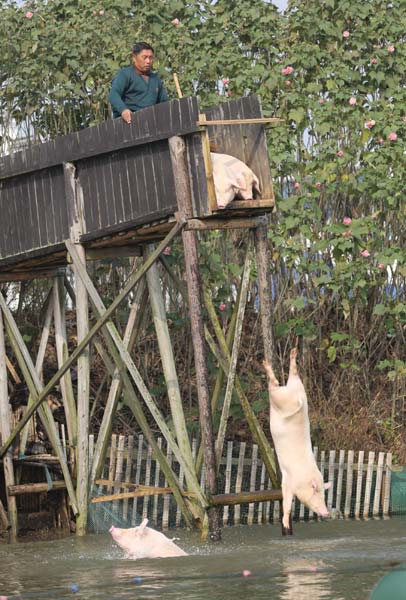
Farmer Huang Demin forces his pigs to dive into a river below to "boost the animals' appetite" at Guanshan village in Hunan province on Nov 11. [Photo/China Daily] |
"That's what we are doing now (with the general principles) — telling the public what animal welfare is and how it should be assessed."
According to experts who took part in writing the forthcoming regulation, the reasons behind wanting to protect animal welfare are both commercial and ethical.
Whatever the motivation, for Min Chengjun, manager of fresh produce for Yurun Group, a pork company in Jiangsu province, quality is a driving force to changing attitudes.
"Take, for example, preventing disease," he said. "Improving animals' living conditions and putting them in a hygienic environment prevents diseases and therefore boosts profitability.
"Also, when animals are under great stress, it results in lower-quality meat," he said.
Min added that sufficient research shows that when pigs are upset, their meat becomes pale, soft and exudative; or dark, firm and dry, affecting its price.
"It's simple: Consumers want to buy meat from healthy pigs," Min said.
Maintaining trust
Farmers have been keeping livestock for human consumption for thousands of years, and experts agree that the vast majority of farmers already understand that their fate is inextricably linked to the well-being and quality of their animals.
Yet, as the country has continued on a path of rapid urbanization, the gap between farmers and consumers has widened, causing distrust, according to Qiao Lu, director of the Beijing Sanyuan Luhe Dairy Cattle Center.
"Consumers know less and less about the way farm animals are treated," he said. "For us, the adoption of standards that meet animal welfare requirements is necessary to maintain confidence in livestock products."
Qiao said his company, one of China's largest dairies, began to adopt animal welfare policy 12 years ago and saw its annual milk yield rise from 6 to 7 metric tons to about 11 tons.
Pressure from fulfilling international obligations and combating "green" trade barriers also provided motivation for the new guidelines, according to Jia Zili at the animal health service and welfare branch.
Jia said the regulation is framed under the basics of the Terrestrial Animal Health Code, issued by World Organization for Animal Health, of which China is a member state.



Go to Forum >>0 Comment(s)