There are some key rules regarding the appearance of the hostesses at the medal ceremonies. They need to be natural and simple, but still distinct enough to look good on TV. Crucially, they cannot afford to be so eye-catching as to drown out the main reason for the celebration, the athletes themselves.
Male flag-raisers will be dressed in attire that emphasizes the beauty of strength, health and youth.
It is said the professionals can create even the most complicated of the four designated hair designs in just 5-10 minutes.
The podium dresses of the Chinese delegation were unveiled last week. Red and yellow are the basic colors and the dresses feature the "Xiangyun" (lucky clouds) patterns on the shoulders and sleeves, which designers say were quite difficult to produce. The outfits come in 17 sizes.
Organizers started receiving the entries last February and the winning design was selected from more than 2,000 entries.
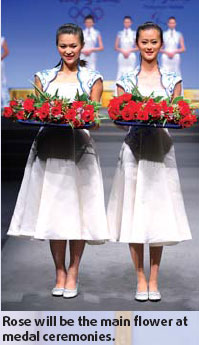
Awarding flowers
Rose will be the main flower at medal ceremonies. Winning athletes will receive nine red roses, as red is the luckiest color and the number nine means everlasting in Chinese tradition.
Certificates
According to Olympic convention, the first three winners get medals, and the first eight winners get certificates. Organizers have chosen brocade, silk and Chinese art paper produced in Xuancheng, Anhui province, as materials for the certificates, in view of their durability.
Unearthed relics show that these materials can last for more than a thousand years.
Posters
The formal publication of the 16 posters for each of the Olympic Games and Paralympics started on last Sunday, with each valued at 10 yuan ($1.47).
Featured in the three categories - architectures, culture and sports - the posters have the same motto, "One World, One Dream", as that of the Beijing Olympics.
Many Chinese elements, including traditional Chinese painting, have been integrated into the design of the posters, reflecting China's unique culture and passion for the Games.
"The history of the poster, in a sense, reflects the history of the Games," says Zhao Yanqiu, deputy director of BOCOG Culture and Ceremonies Department. BOCOG launched a campaign on May 23 calling for poster designs and received 930 entries within a month.
(China Daily July 22, 2008)