Mozart’s opera The Marriage of Figaro has been performed countless times and now a Chinese director is trying to make this comedic opera popular among the public.
|
|
|
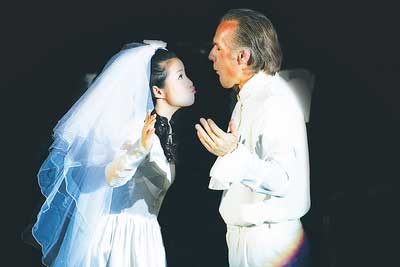
Scenes from the Chinese version of The Marriage of Figaro. [Global Times]
|
Last weekend in Beijing, a new adaptation sheds a new and very Chinese light on Mozart’s 18th century masterpiece.
Entertaining and often hilarious, this version also contains local dialects to bring the opera bang up to date in modern China.
Popular themes occupying the minds of the audience all find a place in the libretto —including the soaring price of real estate, swine flu and pollution.
Though the production’s arias will be sung in its original Italian, the narrations in between will be delivered in Chinese instead.
“In China, opera is held by some people as too highbrow for them to appreciate. But we hope to present a true-to-life version to make it more popular with local audiences, so we have added some slapstick and comic moments,” the opera’s director, Li Wei said.
“I don’t think this will break the genuine flavor of this opera. We have maintained Mozart’s music and Italian arias. Things change over time so we shall provide an opportunity for some modern interpretations, allowing the audience to relate more easily to the characters,” he added.
The Chinese adaptation has an international cast that includes American baritone Brian Montgomery who plays the Count. He will sing in Italian but will deliver the narrations in Chinese.
“This is really a very bold and interesting adaptation. There is even ancient Chinese poem in between and I think it is really funny for the audience to see an American reciting Chinese poetry in an Italian opera,” noted Montgomery who said he was working hard to improve his Chinese pronunciation.
“I like the adaptation because it is all about the audiences being able to understand and enjoy the Mozart classic. I think it is a good way for the Chinese audiences to have an understanding of this opera first off so they can begin to appreciate it more,” he added.
“In the West, we use similar practices to adapt operas to cater to the taste of a local audience. For example, the Metropolitan opera in New York staged an English version of the German opera Die Fledermaus. They adapted the dialogue and the script instead of literally translating the lines from German to English, which is more culturally accessible to English speaking audiences,” explained Montgomery.