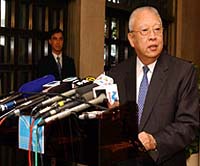
Chief Executive Tung Chee-hwa Thursday ruled out immediate legislation for Article 23 of the Basic Law, saying economic recovery and constitutional reform had a higher priority in the government's work schedule.
Alarmed by rising concern over the subject recently, Tung called a special media session to announce the government's position.
Article 23 deals with national security. After a bill was introduced to enact the provision in local laws last year, a public debate erupted and the government decided to shelve it until after the community arrived at a consensus.
"I notice that legislative work for Article 23 of the Basic Law has again become the focus of concern and discussion among various political groups. The SAR government has a clear position on this matter," Tung told the press.
He said the prime consideration on when to start the legislative process again was that society must first reach a consensus on the subject and the government did not have a schedule for the legislation.
"With the establishment of the new Legislative Council (LegCo), everybody is actively considering their future work priorities," he said.
"For the government, the most important task at hand is to make every effort to sustain our economic recovery and to let everybody share the fruit of this economic growth," the chief executive said.
"Another priority is to map out electoral arrangements for returning the chief executive and the LegCo in 2007 and 2008 respectively," Tung said. "Therefore, we have no plans for the time being and will not seek to start afresh the process for legislating Article 23."
As to when the process may start again, he said the government would consider the issue only after the community reached a fundamental consensus on the question and after the subjects of economic recovery, economic restructuring and constitutional arrangements were dealt with satisfactorily.
Speaking after meeting with Tung the previous day, DAB Vice-Chairman Tam Yiu-chung suggested it was the right time to revisit the issue of Article 23 legislation as there would be sufficient time over the next four years.
Commenting on the subject, member of the National People's Congress Standing Committee, Tsang Hin-chi, agreed that the question should be considered again only after a consensus was formed in the community and the economy was sound.
Executive Councillor Cheng Yiu-tong said it would be important for the community to arrive at a consensus on the question.
Meanwhile, Tung continued his charm offensive to cultivate ties with legislators-elect for closer co-operation in future, meeting with LegCo's second and third largest political groups, the Liberal Party and Democratic Party, separately.
Liberal Party Chairman James Tien, leading a delegation of six to the meeting, said afterwards that while the party respected the government's position on the subject of Article 23, they believed it would be wise to start the consultation early to allow sufficient discussion in society if the provision was to be enacted during the chief executive's current term.
Tien said that at the meeting, they also proposed to enlarge the Election Committee that would return the chief executive in 2007.
Democratic Party Chairman Yeung Sum said the atmosphere of their meeting with Tung was amicable and they looked forward to communicating more with the authorities. At the meeting, Yeung said they again asked about the subject of home-visit permits for the party members. Nine "democrats" attended the meeting.
In another development, Deputy Director of the Liaison Office of Central People's Government in Hong Kong Li Gang said after a public function that arrangements were being made to meet with legislators-elect of the "pro-democracy" camp.
Deputy director Zou Zekai of the Liaison Office Thursday met Margaret Ng of the Article 45 Concern Group.
Meetings with other members of the group -- Audrey Eu, Alan Leong and Ronny Tong -- who are fresh from winning the Legislative Council election, were arranged for today.
After the two-hour meeting, Ng called the atmosphere very frank and enjoyable. "We shared the same views on certain issues, such as doing well the work of the Legislative Council, and improvement of the executive-legislative relation," she said.
(China Daily HK Edition September 17, 2004)
|