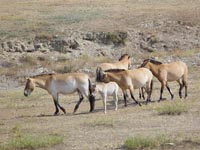
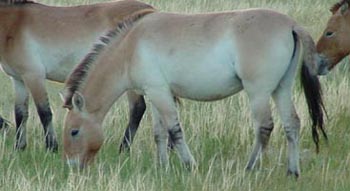
Wildlife protectors in western China are optimistic that a rare breed of indigenous wild horses are once again roaming their homeland.
After days of tracking 10 Prezewalaski horses in northwest China's Junggar Basin, experts have found they are all surviving independently after being set free 10 days ago.
The horses, named after a Russian in 1881 who hunted and collected specimens of the animal, have been raised at a breeding centre in the Xinjiang Uygur Autonomous Region, 240 kilometers from where they were released into the wild.
"We can't really say they've already adapted to the wild environment because it's too soon," said Wang Zhishan, an official with the Prezewalaski's Horse Propagation Center.
This is the second time the center has released horses into the wild.
Twenty-seven were set free in August 2001, but four died of hunger and hypothermia, one was reported missing and some newborn foals were killed by others in the group.
"Fortunately, there are still some left," said Wang. "The group is growing."
Three foals born last year are still healthy and there have been another two born since.
The Prezewalaski's horses are rarer than pandas and on China's first-class endangered species list.
Less than 1,000 Prezwalaski horses are now kept in zoos and by horse-breeders around the world. The center now has more than 140 of them.
Of the latest release, three were young males but too young to mate.
They will face immense challenges adapting back to the wild after a life of relative luxury at the breeding center, now having to fight their own territorial battles and find their own water sources.
Summer and the first month of autumn should be the easiest time but how to survive the winter is still the biggest obstacle.
Wang says the center sent experts out to help them through it last year.
Drought has become an even more severe problem in the Junggar Basin.
Living in the wild may be tough, but captivity, where there is no room to run, mate or get used to the environment, was not the answer, said director of the center Cao Jie.
(China Daily August 9, 2004)