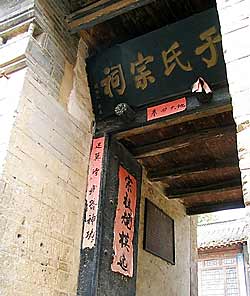
Some of ancient Chinese legends have much to do with stone. In Journey to the West, the Monkey King is said to be born from a rock, while the goddess Nu Wa cuts rocks to support the falling sky. The love stories of the classic A Dream of Red Mansions were recorded on a huge rock. All these legends are related in one way or another to stone culture.
One cannot help but be impressed by the efforts to carve a living and a unique lifestyle out of stone by the residents of Yujiacun.
The village lies 15 kilometers from the seat of Jingjing County, near Shijiazhuang, an important city on the Beijing-Guangzhou railway. Near the Taihang Mountains in the western part of the province, it is rich in ancient stone houses, stone streets, stone wells and stone terraced fields, a virtual encyclopedia of stone culture, so to speak. It is one of the important historical sites under the province's key protection.
The Yus in the village are the offspring of Yu Qian, a politician and national hero of the Ming Dynasty. His grandson Yu Youdao moved to the barren, rocky wasteland in 1468. According to his notes, he "built houses of wood and stone for residence and hunted deer for food." He had five sons and their descendants have lived in the village for 24 generations over more than 500 years.
The hard natural environment has tempered the character of the villagers. They have chiseled through the rocks that lie everywhere, turning them into residential houses and daily utilities, and used them to build terraced fields on the rocky mountain slopes.
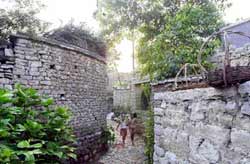
The village has six east-west streets, seven north-south streets and 18 dead-ended hutongs all covered with rocks, huge and small, color-patterned or black-green, as if part of a vivid picture of stone. The age-old stone gate towers lead to stone caves, flat-roofed stone houses or stone houses with tiles that are well wedged to the surrounding terrains. When you roam through the village, you will be moved by the sturdiness and toughness of the spirit of the local farmers' stone cultue, a life virtually chiseled out of rock. If it is raining, you will see all the stones in the streets that have been ground by human feet and animal heels over the ages glitter in the raindrops. It is an ideal setting for an expression of poetic sentimentality and nostalgia.
The grandest of all the stone houses is the Sihelouyuan or the Quadruple Yard, a towering brick structure on stone foundations built in the late Ming Dynasty. It has over one hundred rooms, covering nearly 1,000 square meters. It is separated into the eastern yard and the western yard, rising from the north to the south.
On the second floor of the spacious and tall main building are guest rooms with thick wooden beams Neighboring the guest rooms is a long corridor offering magnificent views of Nanshan Mountain. A row of flat houses stands on the western side. They were the rooms for the hired farm hands and other workers. The family produced 12 scholars during the Ming and Qing dynasties, a remarkable achievement for a family living in such a secluded mountainous area.
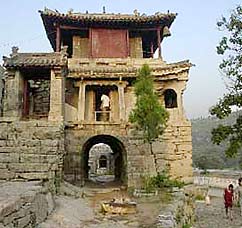
At the eastern entrance of the village is the Qingliangge, the Clear and Cool Pavilion, also named Shenxiange, the Pavilion of Fairies. It is the landmark building of the village. Dating back to 1581, the ninth year of the reign of Emperor Wanli, village legend has it that the entire structure was built by Yu Xichun, a man of immense strength. Yu intended to build nine stories, however when he came to the second story, he injured his hand. You can still see the blood stains on the stone ground. The third story, a wooden structure, was added later by the villagers. The columns and beams are painted or carved. At the eastern door hangs a stone board on which two boys embracing a spotted deer are carved. Strangely, it dances in a breeze while it remains stationary in a gale. At the southern door is a sculptured dragon head carved in fluent and round strokes. The fan-shaped board over the door is inscribed with the name of the pavilion in gold.
Another surprise is that such a large building has no foundations. It stands on a base of huge rocks. Some of these rocks are several meters long, some weigh several tons and others are as crude and primitive as any you may find in barren mountain ravine.
The noodles made by the villagers by hand from sweet potato flour and wheat flour are a local speciality. Lodging in a stone yard home with three meals included costs 15 yuan per day.
Getting there: Take bus 203 bound for Jingjing from Shijiazhuang Railway Station (5 yuan). Then take the bus bound for Yujiacun village in Laowuo (3 yuan).
(Beijing Today October 11, 2004)
|