"Red tourism" promotions will be a major travel theme in China this year.
This promotion aims to speed up the growth of the local travel industry through 2010 as well as to promote economic development and "national ethos," according to an official source.
During the first phase, from 2004 to 2007, the focus is on establishing a preliminary "Red tourism" framework based on 100 sites highlighting 30 tourist routes and 12 major zones.
Infrastructure in these sites will be further enhanced to realize the all-around development of "Red tourism," the goal of the second phase, according to the program.
"Red tourism" destinations, including Jinggang Mountain, Yan'an, Xibaipo and Taihang Mountains, are mostly in economically weak, land-locked areas.
The state will create policies supporting travel agencies to manage "red tourism" routes. Various businesses and social organizations are also encouraged to participate in the construction and management of the sites.
Certain "Red tourism" routes are already in the planning stages.
Tian'anmen Square—National Museum—Marco Polo Bridge
Tian'anmen is a travel must for tourists to Beijing, with the Monument to the People's Heroes and the Mao Zedong Memorial Hall located at its centre. The world's largest public square is often the first stop for visitors in the capital.
On the east side of the square is the National Museum. Hundreds of thousands of relics illustrating China's revolutionary history are on display there.
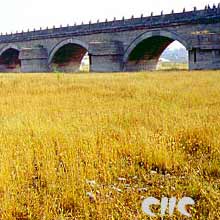
Marco Polo Bridge or Lugouqiao, is one of earliest segmented stone arch bridges and is only about 16 kilometers southeast of downtown Beijing.
The bridge is 260 meters long and has 250 marble balustrades supporting 485 carved stone lions. First built in 1192, the original arches were washed away in the 17th century, but later repaired.
Tian'anmen Square can be reached by many subway lines; For the bridge, take bus routes 309, 310, 339 to Tanhuangchang (Spring Factory) and head north a few hundred meters.
Xibaipo Revolutionary Site
Located 80 kilometers northwest of Shijazhuang, the capital city of north China's Hebei Province, Xibaipo was the village where Communist leaders established their base between 1947-1948.
The original village was submerged when the Gangnan Reservoir was constructed, but this replica was created nearby. Xibaipo also has a Revolutionary Memorial Museum.
More than 60 hotels, actually renovated farmhouses, are now available in Xibaipo. Hebei Province is home to 118 "Red tourism" sites, which attracted 12 million visitors in 2004.
Many train routes reach Shijiazhuang from Beijing. The journey is usually about two hours long. After getting to Shijiazhuang North Railway Station, special bus routes to Xibaipo can be found there.
Jinggang Mountain (Jinggangshan) in Jiangxi Province
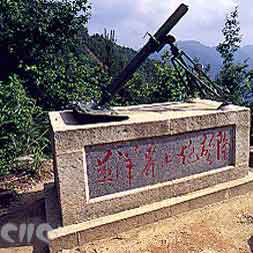
Located on the border of Jiangxi and Hunan provinces, Jinggang Mountain is the mid point of the Luoxiao Mountain Range. In October 1927, the Autumn Harvest Uprising troops led by Mao Zedong marched to Jinggang Mountain and set up the first rural revolutionary base there.
In late April, 1928, the remaining army led by Zhu De and Chen Yi met there to join the army led by Mao Zedong and to set up the 4th Red Army. Jinggang Mountain has become a popular tourist destination. The site is especially intriguing because of its historical past, bamboo forests and stunning waterfalls.
A 20-hour trip from Beijing's West Railway Station will get you to the historic mountain.
Yan'an in Northeast China's Shaanxi Province
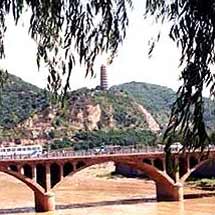
Yan'an was the headquarters of the CPC and also the finish of the Long March in the 1930s.
Most visitors come here to visit the relic sites and cave dwellings where later Chairman Mao Zedong and other Chinese Communist leaders lived before 1947.
The Revolutionary Museum has an interesting collection of exhibits displaying the period of Yan'an's historical importance. Exhibits here include old uniforms, weapons and photos. The Former Revolutionary Headquarters include buildings and dugouts used by Mao Zedong, Zhou Enlai and other leaders for meetings and as an operations centre during their time in Yan'an.
The area is a very popular and very patriotic spot for Chinese visitors.
Traveling to Yan'an is more convenient by plane. Trains run from Beijing's West Train Station to Xi'an daily and can offer you a connection to Yan'an.
(Beijing Weekend March 14, 2005)
|