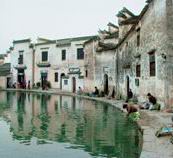
"A place without mountains and rivers is not an ideal home" is a common axiom for architects in Anhui Province. Xidi and Hongcun, two villages in the province's Qianxian County, are World Cultural Heritage sites, and they follow the rule to a T.
Xidi Village is surrounded by mountains on all sides, with two crystal-clear brooks running through it. The
main roads in the village are one street and two paths than run along the banks of the brooks stretching from north to south.
Hongcun Village is well known for its water. Viewed from above, the village resembles a buffalo with its head up and its feet striding. Its main brook, 400 meters long, winds through the village and empties itself into a pond named Yuetang. There are four bridges in the west of the village. The mountain makes the head of the cow, trees the horns, houses the body, and bridges the feet.
Its unique layout and idyllic scenery give the village its reputations as "The Village in a Traditional Chinese Painting." More valuable are the 3,500 ancient dwellings built during the Ming (1368-1644) and Qing (1644-1911) dynasties, which have been preserved intact.
Anhui architecture is famous for its carvings on stones, bricks, and wood, which can be seen in Xidi and Hongcun.
In Xidi Village, the majority of door and window frames and walls are built with carved stones. Brick carvings adorn the roofs, upper portions of gates, and walls, while woodcarvings decorate sitting rooms, wallboards, and pillars. The carvings, no matter what material, vary in pattern, have elegant compositions, and are novel in craftsmanship.
Among the hundreds of dwellings standing in rows in Hongcun Village, Chengzhi House is the best example of the architectural style of southern Anhui. Covering an area of 2,000 square meters, it was built by a salt merchant in the Qing Dynasty. Constructed of brick and wood, the house stands in an imposing manner and features delicate decorations. The crossbeams, dou gong (pendentive) doors, and window frames are decorated with carvings that depict numerous figures with varied facial expressions and are considered the gems of Anhui-style carving.
Not only do the mountains and rivers add beauty to the ancient dwellings in Yixian but they also protect them. Isolated from the rest of the world by inconvenient transportation, the area has escaped attacks by outsiders and the influences of modern economic impacts, staying as unadorned and as pure as they always were.
Notes for traveling:
1. Transportation: Minivans to Xidi Village are available at the Yixian main bus station. Motor rickshaws are available to Hongcun Village. You don't have to get off at the county seat of Yixian if you start from Tunxi, where the municipal government of Huangshan is located. Just follow the signs to Xidi Village.
2. A small group is best for a visit to the ancient dwellings. This minimizes the noise of a big crowd that could interrupt the tranquility there.
3. Visitors can buy one or two brochures of the villages for future memory.
4. Staying overnight in Hongcun Village is a good choice for travelers.
(China Pictorial June 26, 2004)
|