Skin deep
- By Casey Hynes
 0 Comment(s)
 Print
Print E-mail
Global Times, July 12, 2011
E-mail
Global Times, July 12, 2011


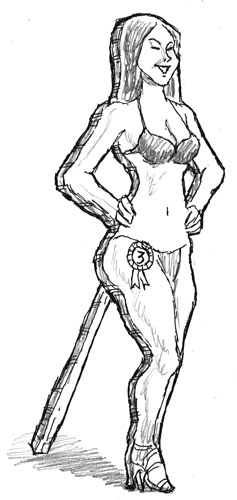
I went along to the Miss China Universe pageant Sunday night to witness the crowning of Miss China Universe 2011. I used to love watching the Miss USA and Miss America pageants as a child, and was curious to see how Chinese beauty contests would compare.
The pageant started out with a dance routine that appeared to make most of the contestants uncomfortable. And why not? These women were in their 20s and were trotted out to give a performance that looked like a middle school show choir routine. This was followed by the swimsuit and evening gown competitions, spread out over the course of two hours, during which musicians Miri Ben-Ari and David Garcia performed and the audience was treated to video footage about the training the contestants underwent to prepare for their big night.
From what I gathered, the women's sole function was to stand on stage, a smile plastered on their faces while they stood perfectly still in order to be critiqued and judged by all. It reminded me of horses being examined for purchase.
I don't know what pageant expectations are in China, but I've heard talk in the US that these are more than beauty contests. They are about talent, personality and scholarship.
I have seen no evidence, in the US and now in China, that beauty pageants are anything other than a test of who can stand straightest, smile biggest and look prettiest.
In the Miss Universe China pageant, only three women performed in the talent portion. Only the final four were asked interview questions and given an opportunity to express any kind of opinion. The rest of the time, the women stood on stage, beautiful, elegant, flawless. And silent.
At the Miss USA pageant, which was held recently in Las Vegas, each contestant was asked whether evolution should be taught in schools, a subject of heated, almost maniacal, debate in the US. For the most part, the candidates were painfully ill-informed, uncomfortable with the question and very obviously trying to please all demographics and judges, which is no doubt what they had been trained to do.
But they were also all beautiful, perfectly coiffed, immaculately dressed and had big smiles planted on their faces. And in most of the world, that appears to count far more than intelligence or individuality.
The problem I have with this - aside from the obvious, which is that it's demeaning and has to be damaging to any real kind of self-esteem or sense of self-worth - is that these women are held up as the standards to which young girls should aspire. I'm not saying that the women in these pageants are not unique, kind, interesting or smart. I'm sure they are. But those are not the qualities that are celebrated about them. And those are not the qualities encouraged in young girls. Being a manufactured kind of beautiful, speaking only non-controversial words and being a champion people-pleaser. That's what gets you ahead in life.
I have seen first-hand, in the US and in Asia, what this kind of attitude does to girls at young ages. Nine-year-olds proclaim themselves fat, and do the same to their friends, creating a vicious cycle of insecurity and cruelty as they grow older. I used to teach 4-year-old girls who were not allowed to have second helpings of food at lunch, and whose parents forced them to undergo laser surgery to correct imperceptible flaws in their still baby-like skin.
For two global superpowers, the pageant mentality in both China and the US seems backward. The recent popularity of contests such as American Idol, where young dreamers display their talents before po-faced middle aged judges, awaiting the thumbs up or down on their worth, is a symptom of the same malaise. The fact that beauty pageants, in which the women are both the stars of the night and the least influential figures in the show, still garner so much attention makes it clear that when it comes to discussing women and femininity, there's still a long, long way to go.


Go to Forum >>0 Comment(s)