Why not make food, health part of security
- By Ong Suan Ee
 0 Comment(s)
 Print
Print E-mail
China Daily, November 18, 2011
E-mail
China Daily, November 18, 2011


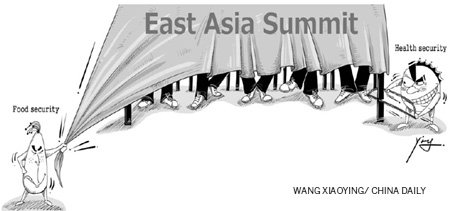
Non-traditional security (NTS) issues have ranked high on the East Asia Summit's (EAS) agenda since its establishment in 2005. Calls for greater collaboration on key NTS issues such as energy security, climate change, disaster management and infectious diseases have featured prominently at past summits. There is, however, a notable absence of EAS discussion on two areas - food security and health security beyond the scope of infectious diseases.
Since the global food price crisis of 2007-2008, food security has occupied a firm spot on the international stage. This has not escaped the EAS, with food security cited as a serious concern at EAS Foreign Ministers' Informal Consultations, notably in 2008 and 2011. But food security appears to be given less importance than other NTS issues considered critical by the EAS.
During the 2008 informal consultation, food security was primarily addressed in relation to its overlap with the energy sector and the need to balance the dual priorities of using agricultural crops for food and biofuel production. Similarly, the 2011 informal consultation in Bali, Indonesia, saw the foreign ministers emphasize greater regional cooperation on food and energy security, recognize the synergetic relationship between food and energy security and encourage balanced, sustainable growth across both areas.
It is evident that the EAS is mindful of the far-reaching, multi-sectoral impact of the challenges of food security on all member states. Therefore, the absence of food security from the agenda of the summits is all the more puzzling.
For example, the 2009 EAS chairman's statement made no mention of food security despite the protracted effects of the global food price crisis. In the 2010 EAS chairman's statement, food security was not identified as one of the EAS' five priority areas, namely finance, education, energy, disaster management and influenza preparedness. It only received brief mention, and even so in the context of reaffirming commitments to further disaster management cooperation.
In arguing whether or not food security should be tabled as a stand-alone concern at the EAS in Bali, we need look no further than the recently released Global Hunger Index 2011. Evidence of the pervasiveness of food security challenges within the EAS is clear: Two out of the 18-member coalition of EAS member states - Laos and India - were found to have "alarming" rates of hunger, while five others (Indonesia, the Philippines, Vietnam, Cambodia and Myanmar) recorded "serious" levels of hunger.
The uncertainty of the global food trade system also provides a compelling reason for the EAS to highlight food security on its agenda. The State of Food Insecurity in the World 2011 report cautioned that food price volatility and high prices are likely to continue and possibly increase in the near future, making farmers, consumers and countries more vulnerable to poverty and food insecurity. This trend has wider implications for all EAS member states, from major food-producing countries like United States, India and China to small, import-dependent states like Singapore.
As to the health security issues, a recent report by the UN secretary-general says about 36 million people die every year from non-communicable diseases (NCDs), which comprise 63 percent of global deaths. Of those, 9 million are under 60 years of age, adversely affecting the number of able, contributing participants to the global workforce. Also, 90 percent of those deaths occur in developing countries, resulting in tremendous socio-economic opportunity costs for emerging and transitional economies.
The rise of NCDs also entails serious health consequences for member states, placing additional burdens on states' health facilities, health care systems and often already stretched medical workforces. This is of particular concern for Southeast Asian members of the EAS.
According to Asian Trends Monitoring, most Southeast Asian countries' health systems are built to manage endemic infectious diseases, not chronic NCDs. It argues that NCD responses across these countries are neither well coordinated nor well funded. Also, continued challenges to policy implementation - such as the increase of NCDs among the urban poor - remain largely unaddressed. So will the NCD issue make its debut at the EAS in Bali?
The absence of the emergent and pressing global issues of food security beyond the scope of energy concerns and health security beyond infectious diseases impedes the EAS' primary goal - that is, to promote member states' collaboration, exchange and cooperation on key regional and global political and economic issues. It would certainly be in the EAS' interest to consider the broader scope of health security and introduce food security at the EAS in Bali.
The author is a senior research analyst at the Centre for Multilateralism Studies, S. Rajaratnam School of International Studies, Nanyang Technological University, Singapore.


Go to Forum >>0 Comment(s)