Public-private imbalance highlights need for reform
- By Fei Xue
 0 Comment(s)
 Print
Print E-mail
China.org.cn, January 10, 2012
E-mail
China.org.cn, January 10, 2012


Recently, Li Rongrong, former chairman of the State-owned Assets Supervision and Administration Commission (SASAC) has generated heated debate with his comment that the often-touted hypothesis that "the state sector advances while the private sector retreats" is a false prophecy.
|
|
|
Li Rongrong, former chairman of the State-owned Assets Supervision and Administration Commission (SASAC). [photo/China.org.cn] |
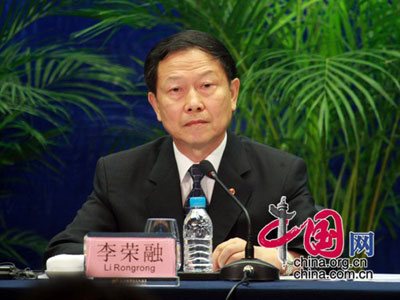
"Instead of talking about the ownership like 'state-owned' or 'non-state-owned', we should support those [companies] with higher efficiency in allocation of resources," Li said. "Without state-owned economy, how can there be such rapid development in the non-state-owned sector?"
The debate on the shift in the balance of power between the public and private sectors in China is not new. When the National People's Congress (NPC), China's top law maker, and Chinese People's Political Consultative Conference (CPPCC), the country's top political advisory body, were in session in March 2010, the then CPPCC spokesman provided data that in 2009, the industrial added value of the private sector accounted for 18.7 percent while state-owned enterprises accounted for only 6.9 percent. Meanwhile, the private sector's gross profits increased by 17.4 percent while profits of state-owned enterprises decreased 4.5 percent.
Some state-owned enterprises (SOEs) have been withdrawing from industrial sectors due to insufficient profits. "Soft budget constraints" of state-owned enterprises, among other factors, have led to relatively meager returns.
In a 2011 research report, the Unirule Institute of Economics pointed out that from 2001 to 2008, the average rate of return on net assets for SOEs and state holding enterprises was 7.68 percent. However, if we were to cut off government subsidies to state-owned enterprises and excess profits due to the monopolies they enjoy, restoring the "true cost", the average return on net assets for SOEs and state holding companies will be -6.2 percent. From this we can see that the profits of SOEs come mostly from land fees, financial subsidies and financing charges.
The vast inequalities in the private and public sectors are not without social costs. Data provided by Dr. Wu Jinglian, professor of economics at the Chinese Academy of Social Sciences, show that the labor's share in the national income was only 39.7 percent, compared to 53.7 percent in 1997 and 65 percent in 1980. In 2008, employees working in state-owned enterprises accounted for 8 percent of national workforce, yet this group took in 50 percent of the total wages earned nationwide. Moreover, China's Gini coefficient, a measure of equality of income distribution, has been steadily rising in recent years, an indicator of the growing rift between the rich and poor.
In attempts to drain liquidity, there have been periods of monetary policy tightening. In 2011, the People's Bank of China raised interest rates three times and raised the deposit reserve ratio six times. The deposit reserve ratio for large banking institutions reached high of 21.5 percent in 2011, more than double compared to 2007. On the other hand, interest rates have been out of line with the market for quite some time. The threshold for private capital to get into financial sector has caused capital chain tension in many small and medium-sized enterprises (SMEs), which in turn has led to a boom in underground lending. In contrast, the credit resources with lower interest rates have mostly been allocated to state-owned enterprises and local governments.
2012 is a critical year for actualizing the goals set forth in the 12th Five-Year Plan (2011-15). In the face of internal and external pressures, how to reform China's state-owned enterprises and maintain strong economic growth will be a major focus of the central government. Recent debate on the imbalance of power between the public and private sectors in fact is an acknowledgement of the urgent need for reform.
Looking back on three decades of the reform process, scholars generally believe that market-oriented reform will continue to serve the major driving force for China's economy. The momentum for China's economic development still lies in private sector. In the coming year, it will be prudent to discuss new avenues of private sector growth as public sector reform continues to take place.
(This article was first published in Chinese and translated by Li Huiru)
Opinion articles reflect the views of their authors, not necessarily those of China.org.cn.


Go to Forum >>0 Comment(s)