Character building holiday destinations
- By Mike Bastin
 0 Comment(s)
 Print
Print E-mail China Daily, May 3, 2012


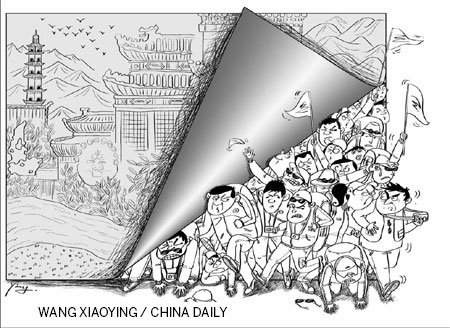
May Day, or International Labor Day to us its official name, resulted in numerous complaints about the congestion and disruption to the transport and service sectors that occurred as tens of millions of Chinese consumers either traveled to scenic parts of China or beyond, or simply spent their free time shopping .
Such havoc on the roads and railways is, alas, a similar tale in most countries where May Day is a national holiday. In the United Kingdom, where the first Monday in May is a holiday, motorists are always warned of probable delays as families hit the highways in search of somewhere to the kids.
I remember with a shudder a recent experience my family encountered over the May holiday in the UK. My wife and I planned to take the kids on a short camping trip to a scenic part of England which required, or so we niavely thought, about a three- hour drive. Unfortunately, due to the permanently disorganized state of affairs that goes with managing a family with young kids, we set out far later than expected and of course ran straight into an almighty traffic jam. The absolute gridlock was so bad that we were left with no alternative but to eat most of the food packed in the car and after not moving for almost five hours we took the decision to turn back and return home. Back at home we promptly erected the family tent in the back garden and camped out there for the next few days instead! Ah, home, sweet home.
In the case of China, however, such pressure on the service sector, where brand building has never been more important, can only be a good thing for the long-term development of an internationally competitive economy.
Over the last 10 to 15 years manufacturing and exports have driven China's incredibly impressive economic emergence. But over the next 10 years or so it is domestic consumption and China's service sector which needs to step up to the plate. The leisure sector in particular needs to play a key contributory role in the next wave of development.
However, the building of competitive brands in the service sector, particularly the leisure sector, is not the same as manufacturing. Service brands are far more people-oriented which means there is far more customer contact.
Brand building in the service sector is, therefore, first and foremost about investment in the staff who design and deliver the end "product": investment in education and training and the establishment of a contented and motivated service delivery team. This, above all, should lead to great efficiency in service delivery and customer satisfaction which will result in fewer complaints from the end users.
Holiday activities commonly include visits to well known tourist attractions across China, which places great pressure on these particular service providers. However, such pressure should be seen positively as it ensures attention to every aspect of brand improvement and customer satisfaction. Brand building, or destination branding as it is also known in the tourism sector, involves a few sector-specific challenges not faced by other service sectors.
Essential to any success in tourism branding is overcoming the intangible nature of the tourism destination experience. Intangible due to the fact that no preview or trial is possible and no tangible product ownership results from the experience. Overcoming this or "making tangible the intangible" can be achieved through the personification of the service brand, that is to say, the firm and lasting association of the brand with a suitable, real life or imaginary figure . Such an association forms a tangible image and emotional impression in the mind of the consumer. Tourist attractions which target children should of course consider new and innovative cartoon characters in order to personify the service brand and make it tangible to kids.
In general, effective personification will take place according to the "fit" between the target market's desired brand experience and their use of the character used to establish the brand personification. For example, a relaxing holiday resort for middle aged couples requires not just an association with, and promotion of, a famous, attractive person of a similar age but also someone who carries a relaxing, charming image too.
China's holidays are an essential catalyst for the development of the service sector and service brand building and necessity is the mother of invention.
The author is a visiting academic at Tsinghua University and researcher at Nottingham University's School of Contemporary Chinese Studies.


Go to Forum >>0 Comment(s)