China must deal realistically with smaller neighbors
- By Tim Collard
 0 Comment(s)
 Print
Print E-mail China.org.cn, December 18, 2012


This week I am writing from the Philippines, a delightful country with a year-round warm climate and lovely, friendly, family-oriented people. It is, of course, a regional neighbor of China and a fellow Asia-Pacific Economic Cooperation (APEC) member. The Philippines enjoys a unique mix of cultures; an Asian people with a deep-seated Hispanic and Catholic-Christian ethos, with a lively Americanized surface and an admixture of the Chinese commercial spirit. In the city of Cebu I visited a beautifully-preserved Chinese merchant's house from the 17th century, still lived in by the merchant's Chinese-Filipino descendants; it claims to be the oldest Chinese house outside China.
|
|
|
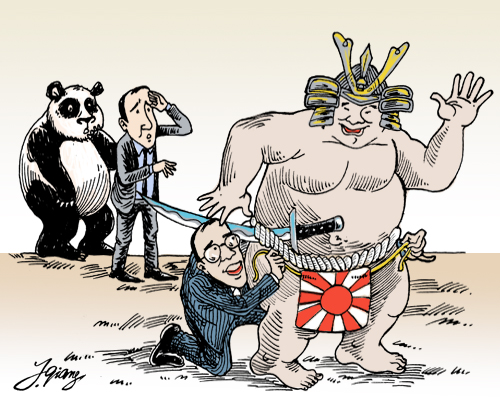
Holding a candle to the devil [By Jia Qiang/China.org.cn] |
The Filipinos have their problems, of course. In the recent turbo-charged development of the Eastern Pacific Rim, the Philippines, like Thailand, has been somewhat left behind. It is difficult to establish precisely what makes some countries flourish and others languish, especially if they are in the same geographical region and come from similar economic circumstances. Is it the climate? Yes, it is difficult to establish a culture of hard work among persistent high temperatures - but Hong Kong has done all right. Is it education? But educational standards in the Philippines are fairly high, and so are levels of English. Is it supplies of natural resources? Korea and Singapore never had much of those. As it seems, the Philippines has most of the prerequisites for economic success.
But ask any Filipino why the country has found prosperity so difficult to achieve, and you will always get the same answer - the country is paralyzed by grotesque levels of corruption. Money does not filter down into the real economy in the way it should, creating investments, enterprises and jobs - too much of it is sticking to people's fingers in the process. Jobs are simply not being created in the Filipino economy; this has given rise to an established tradition of Filipinos looking for work abroad. They can be found all over the Middle East, working in construction and as domestic helpers; they man the world's merchant ships; and, in China and elsewhere, they work in the leisure industry as musicians and entertainers. They are not lazy people; there are just no jobs for them at home.
For economic reasons, the Philippines constitute one of China's weaker neighbors. Is it wise, therefore, for them to challenge China in the South China Sea? There have been a couple of provocations and counter-provocations in the last year related to the Nansha Islands, known in English as the Spratlys.
It is clearly silly for the Philippine Navy to be making aggressive gestures in the region. Whatever the rights and wrongs of the Spratlys issue, the Philippines are never going to be in a position to mount a naval challenge to China. They certainly cannot rely on US support for any such altercation; and I think they are beginning to realize this now. The various US bilateral treaties covering the region are intended only to deter open aggression, whether from China, from Japan, or from any other power; they are certainly not there to give backing to irresponsible provocations. The US naval presence in the region will serve to rein in its allies, not to encourage adventurism.
As such, de facto Chinese dominance of this region is not a threat or an aspiration, but a simple fact. This being so, China has no need to humiliate her smaller and weaker neighbors by rubbing the fact under their noses. The Philippine Government has recently been agitated by the issue of new Chinese passports making specific references to Chinese sovereignty claims in the South China Sea. Now, I am not here challenging these claims: only wondering whether it is a good idea to emphasize them in this way. Naturally, the governments of the Philippines and Vietnam have responded in rather a preposterous way, refusing to stamp the passports but still having to find a way to validate them. As China knows full well, these countries cannot afford to put real obstacles in the way of Chinese visitors and the money they bring in.
Of course China is in a position to make its neighbors jump about in this rather undignified manner; but was it really a good idea? China's neighbors have to be brought to an understanding of the real position in the region. Whatever sovereignty claims may be outstanding, China will for the foreseeable future be the leading regional power, and its neighbors are too weak to challenge her. Having said that, it would surely be better to try to curb the growth of nationalist resentment among the smaller nations; even if impotent, it will only sour relations and hinder development. China has a perfectly sensible regional policy of "seeking common development while reserving differences," and her neighbors are more likely to benefit from friendly cooperation than by the rattling of puny sabers.
The author is a columnist with China.org.cn. For more information please visit: http://www.china.org.cn/opinion/timcollard.htm
Opinion articles reflect the views of their authors, not necessarily those of China.org.cn.


Go to Forum >>0 Comment(s)