Inclusive AIIB promises progress for all
- By Tom Plate
 0 Comment(s)
 Print
 E-mail China Daily, June 24, 2015


|
|
|
[By Wang Xiaoying/China Daily] |
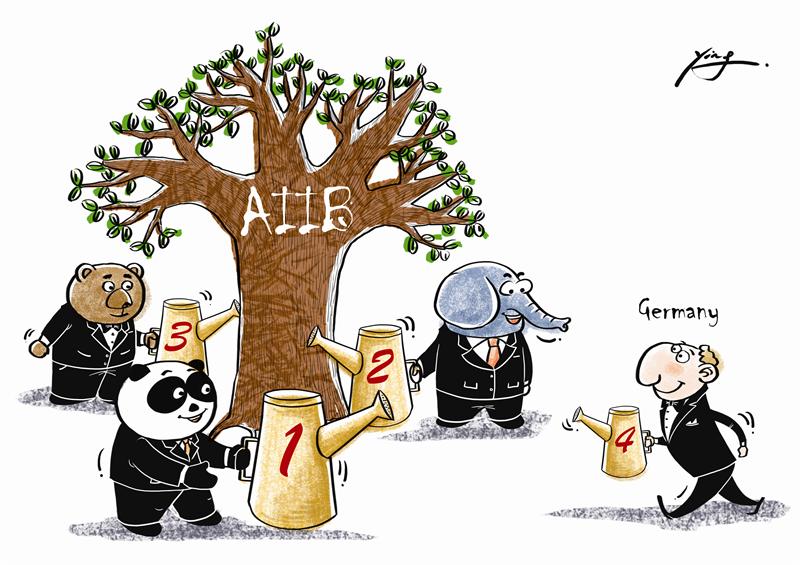
Progress in Asia, or anywhere, depends on the implementation of progressive ideas, and few recent ideas have seemed more progressive to people in Asia - and indeed to people almost everywhere - than the China-proposed Asian Infrastructure Investment Bank.
A glaring exception to the positive reception was to be found in US government circles, where every new idea out of Asia nowadays seems fated to be assessed on the basis of whether it will help Beijing or Washington - but not possibly both. And so the AIIB becomes a "threat".
Blustery binary thinking will be the undoing of intelligent American policy in Asia - and could morph into a continuing migraine for friends and allies across the region, not to mention for China.
The AIIB proposes to be the most grandiose multinational financing mechanism for vast infrastructure development projects in recorded history. It aims to become an investment trigger extensively melding Europe and Asia into a massive matrix of rails, roads, ports, airports, logistics parks and other facilities - a network of interconnectivity as far as the mind can conceive and the eye can see.
This modern matrix is aimed at fusing inland China with the Gulf of Thailand, Bay of Bengal, Arabian Sea, Persian Gulf, Mediterranean Sea, North Sea, Baltic Sea and other waterways. But rather than being a really new idea, it is a new approach to a very old concept - a trademark innovation of the Han Dynasty (206 BC-220 AD). This gives us some idea of how genetically embedded in China's DNA is the "new" infrastructure matrix. In fact, it's the Silk Road project reborn, with the AIIB as the financing midwife.
This is the real and big story that some people in the United States have totally misread. But when the mind of the West reflexively defaults into the belief that any "win" has to be somebody's "loss", all sorts of misconceptions arise. And so it was imagined that the AIIB was a menacing attack - a clandestine threat - to the Washington-based World Bank, and even to the International Monetary Fund and the Asian Development Bank.


Go to Forum >>0 Comment(s)