AIIB, a complicated game
- By Tang Min
 0 Comment(s)
 Print
 E-mail China.org.cn, June 27, 2015


The Asian Infrastructure Investment Bank (AIIB) is the first multilateral international financial organization launched and led by China. It is a victory for Asia as well as for China.
|
|
|
[By Zhai Haijun/China.org.cn] |
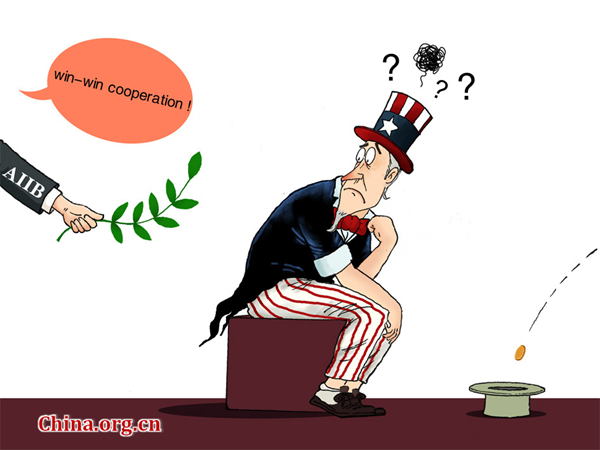
Earlier this year, many media reports predicted that developed countries would not join the AIIB. However, beginning this March, Britain took the lead among developed countries and applied to join the bank. Following that, several countries including Germany, France and Italy applied. To date, 57 countries have applied to be founding members of the AIIB.
What will allow the AIIB to succeed? What challenges exist for its future operations, and how will the bank face them? And what can China learn from the AIIB?
The current international financial order was determined at the Bretton Woods Conference on the eve of the end of World War II 70 years ago. Three important international organizations – the International Monetary Fund, the World Bank and the World Trade Organization – were established at that conference.
But today, the current financial order and structure are showing signs of malaise. The aforementioned international organizations are guided by the United States, which even has veto power over them. Reform of the present system is needed. The AIIB has come into being at the right time to do this.
Asia is now developing rapidly, but it has reached a bottleneck caused by infrastructure, which will require of US$800 billion in annual investment to reach the average level of the world. The interesting thing is that Asia does not lack money. By the end of last year, Asian countries had US$7.3 trillion in foreign exchange reserves, but a mechanism is needed to convert these foreign exchange reserves into investment funds.
Chinese enterprises are now expanding throughout the world. Last year alone, their direct investment abroad totaled US$120 billion, much of which went to Asia. Better state development, stable politics and rapid economic development are closely related to China's own benefits. The AIIB offers solutions to barriers to infrastructure investment (one of China's strong points), and Asia's development needs and demand for the reform of the world financial system.
The AIIB faces many challenges, however. First, how will the AIIB operate? What sort of system will form the basis of its structure? Once the AIIB has been created, how will it prevent low efficiency, and how will the AIIB's current US$100 billion to attract more private funds while reducing risks for investors? Can the AIIB redesign world financial systems through the concept of "internet plus"? How will it make use of crowd-funding? Can it employ e-commerce models?


Go to Forum >>0 Comment(s)