Stock market slump will have only a limited impact on economy
- By Xu Hongcai
 0 Comment(s)
 Print
Print E-mail China.org.cn, July 13, 2015


|
|
|
In the heat [By Jiao Haiyang / China.org.cn] |
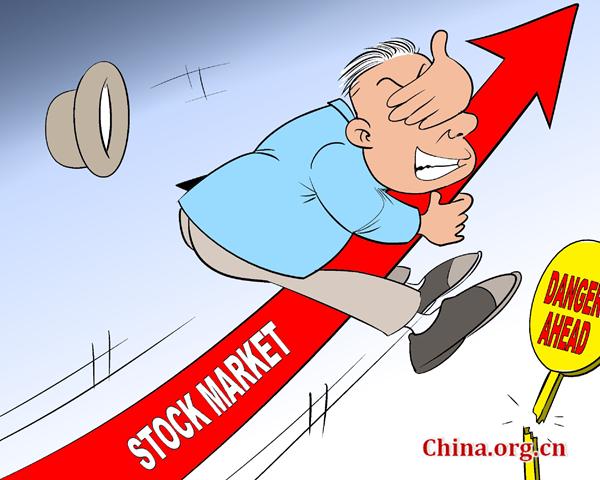
The A-share market has been undergoing an unprecedented plunge since mid-June, with the benchmark Shanghai Composite Index having declined about 30% and the capitalization of listed companies having shrunk by about 20 trillion yuan (about $3.23 trillion). Despite of the downside pressure, the fundamentals of the Chinese economy still remain strong and the economic growth is still within a reasonable range. In the first quarter, GDP growth was 7%, and the growth rate for the second quarter is expected to range from 6.8% to 6.9%. Driven by the current proactive fiscal policy and prudent monetary policy, it is forecast that the growth in the third quarter will rebound to 7%, and will continue to maintain at 7%. The full-year GDP growth target of 7% could be attained, and the goal of creating 12 million new urban jobs would also be achieved. The ongoing massive nosedive in stock indexes, therefore, runs counter to the stable performance of the Chinese economy.
Judging from the nature of the stock market, the slump could be defined as a natural correction of the huge surge in the past months, and was triggered off by a slew of factors, including profit-taking, offloading by executives of listed companies, position closing by leveraged funds and short sale for hedging in the index futures by institutional investors. These factors ultimately led to panic sell-offs by retail investors and the happening of the recent massive declines. Both the massive surge in the past months and the recent slump could be described as irrational, and they reflected the facts that China's stock investors are still not matured enough and the government regulatory departments failed to perform well their duties and functions in regulating the securities market. In particular, when leveraged financing from non-official channels ran rampant, the regulatory departments failed to spot the danger and issue warnings or took measures to prevent risks. When new shares were over-speculated at their debuts, the regulatory watchdogs failed to take effective measures to rein in such a rampant and common phenomenon. And when the stock indexes started to plunge and the market became panic, relevant government departments resolutely took measures to intervene in an attempt to prevent irrational and unprecedented declines. For the government, this is a must-do option, otherwise the consequences could be unimaginably disastrous.


Go to Forum >>0 Comment(s)