China, Japan, ROK shoulder heavy responsibilities in FTA
- By Ni Yueju
 0 Comment(s)
 Print
Print E-mail China.org.cn, November 8, 2015


|
|
|
Chinese Premier Li Keqiang (R), Japanese Prime Minister Shinzo Abe (L) and South Korean President Park Geun-hye attend the sixth China-Japan-South Korea leaders' meeting in the South Korean capital of Seoul, Nov. 1, 2015. [Xinhua/Wang Ye] |
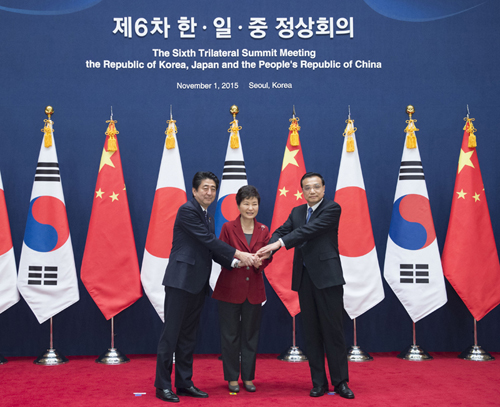
The resumption of the trilateral summit of the Chinese, Japanese and South Korean leaders should be seen against a background of a complicated and sensitive international situation and a sluggish global economy.
It highlights the sincere efforts of the leaders of the three countries to strengthen regional cooperation, maintain regional peace and stability, and drive economic development in Asia and even in the wider world. It also offers hope to the negotiations of the trilateral Free Trade Agreement (FTA) now making slow progress.
Trilateral cooperation is a trend of the times
China, Japan and South Korea are Asia's main economies with a global presence. They have a total GDP of more than US$16 trillion, more than 70 percent of Asia's total. The economic and trade relations between the three countries are very close, approaching US$700 billion a year.
China is South Korea's largest trade partner, its largest export market and a major source of imports, and its second largest overseas investment destination; South Korea is China's third largest trade partner. Similarly, China is Japan's largest trade partner, while the latter is the third largest source of foreign investment in China. Japan is one of the three major trade partners of South Korea. Therefore, the strengthening of economic and trade cooperation between the three has an important significance in promoting regional integration and global economic recovery.
The mechanism of the trilateral China-Japan-South Korea summits suffered a setback after the fifth one in Beijing for reasons known to all, leading to an obvious decline of economic and trade volume.
The bilateral trade volume between China and Japan declined by 5.1 percent in 2013, particularly with China's imports from Japan down by 8.7 percent; while South Korea's exports to Japan declined by 10.7 percent and its imports from Japan declined by 6.7 percent. Although trade between China and Japan slightly improved in 2014, it still presented negative growth. Furthermore, Japan's investment in China fell by 32.5 percent in 2013 and 38.8 percent in 2014.
Various factors were involved, including a sluggish global economy, weak market demand, China's "new normal" growth model, and economic structural adjustment in Japan and South Korea. No matter for what reasons, they act against the common interests of the three countries and the world in general.
Facing slowdown, China, Japan and South Korea increasingly don't want political differences to affect their common economic interests. In this context, the resumption of the mechanism of trilateral summits is hopefully a way forward.
In a joint declaration for peace and cooperation in Northeast Asia issued on Nov. 1 after the summit in Seoul, the three nations stressed strengthening economic cooperation and accelerating FTA negotiations so as to finally conclude the comprehensive, high-level and mutual beneficial agreement.


Go to Forum >>0 Comment(s)