Metropolises compose major economic growth force
- By Nie Riming
 0 Comment(s)
 Print
 E-mail China.org.cn, January 11, 2016


|
|
|
The substitute [By Jiao Haiyang/China.org.cn] |
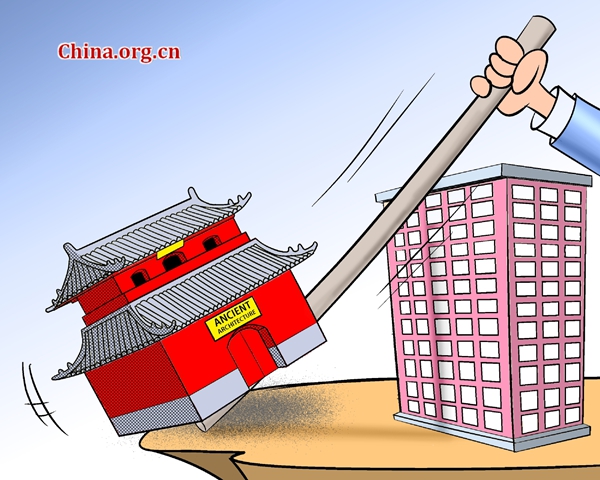
As the trends of economic development and population aggregation are hardly reversible, any attempt to balance regional economies by rejecting the role of major cities in China will inevitably inefficient.
According to Yang Weimin, deputy director of the Office of the Central Leading Group for Financial and Economic Affairs, China will give rise to a number of new metropolises facilitated with adequate public services as a means of balancing regional development so that economic growth can be stimulated. During the 13th Five-Year Plan period (2016-2020), China is in need of 10 metropolises as large and as affluent as Beijing, Yang added.
Ahead of Yang, who made this remark on Dec. 12, 2015, Lou Jiwei, minister of finance, said the construction of urban belts cannot be completed without the engagement of China's major cities, which can create jobs and send rural peasants to non-agricultural sectors in a bid to boost productivity.
The metropolises often are where large migrations head into, and therefore are the major force to push forward economic growth. With more access to jobs and higher salaries thanks to the substantial investments in those cities, they are attracting incessant inflows of labor forces. There were 11 provinces and municipalities, including Beijing, Tianjin, Jiangsu, Zhejiang, Guangdong, Fujian, Liaoning and Jilin, with their GDP per capita exceeding the average level in 2013. Their high GDP per capita is probably a result of high quality investments or high personal salaries, which can lure considerable labor forces.
However, the incumbent system of residential permits has substantially constrained the free flow of labor forces towards these developed regions. The situation is well demonstrated by the stunning regional gap in view of polarized GDP per capita. In 2014, the total GDP per capita of nine provinces and municipalities, including Beijing, Tianjin, Hebei, Jiangsu, Zhejiang, Shanghai, Guangdong, Fujian and Shandong, accounted for 54.45 percent of the entire country, whereas the population in those regions only summed up to 29.4 percent.
Tracing back the development in the past three decades, it has been shown that economic and demographic resources have always flowed to the abovementioned regions. The GDP from the nine regions reached a pinnacle of 58.95 percent in 2005, followed by declines in the ensuing years as a result of the government's macro control policies rather than market drives.
The government attempts to balance the regional development by providing considerable loans and quotas of land used for buildings construction to the northeast as well as the landlocked middle and western areas of the country. Moreover, it has tightened control over the size of investments and population in large cities in hopes that the resources will be better utilized for the revival of the northeastern region as well as for the construction of public facilities in the middle-and-western areas.


Go to Forum >>0 Comment(s)