China, Latin America and the Caribbean strengthen ongoing ties
- By Vicki Cann
 0 Comment(s)
 Print
Print E-mail China.org.cn, November 23, 2016


|
|
| Chinese President Xi Jinping meets with his Peruvian counterpart Pedro Pablo Kuczynski in Lima, Peru, Nov. 20, 2016. [Photo/Xinhua] |
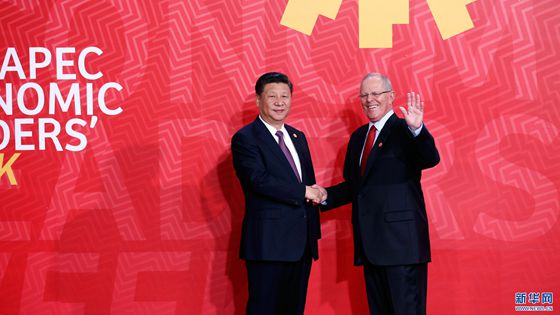
2016 has proven to be a truly historic year for China having hosted the G20 Summit. This year will also be remembered for China's concerted effort to strengthen its ties with Latin America and the Caribbean. March witnessed the launch of the 2016 China-Latin America and the Caribbean (LAC) Year of Cultural Exchange with the goal of promoting greater understanding among the people of China, the Caribbean and Latin America. Having travelled to Latin America in 2013 when he first took office, President Xi's current trip to Ecuador, Chile and Peru marks his third visit to the region.
It is heartwarming to witness President Xi's steadfast commitment to the region as indicated by his visits to 10 countries since he took office three years ago. He is the first president from China to visit Ecuador since the two countries established diplomatic ties in 1980. This gesture certainly signals that China is serious about strengthening the existing bilateral ties with Ecuador by engaging in a more strategic and comprehensive partnership.
Upon his arrival in Ecuador, President Xi was quick to announce China's willingness to support Ecuadorians who were affected by the 7.8 magnitude earthquake through the provision of medical treatment and housing. A new hospital will be built by China CAMC Engineering Co. Ltd in the city of Chone, as one of the major hospitals in this city was severely damaged by April's earthquake. The president reportedly stated that the assistance China provides Ecuador will "have no strings attached [as] a friend in need is a friend indeed."
Asia-Pacific Economic Cooperation Summit (APEC), Peru and Chile
During his keynote speech at the APEC Summit in Lima, Peru, President Xi highlighted the importance of boosting interconnected relationships through economic globalization. He noted that the Free Trade Area of the Asia Pacific (FTAAP) is a tactical measure that would enhance and bring about long-term benefits for the Asia Pacific region. The president affirmed his commitment to revitalizing trade and investment through more open and inclusive free trade arrangements. China's reforms would further open the Chinese market to more foreign companies. These actions indicate China's efforts to narrow the income gap and decrease the existing polarization of wealth. These commitments were timely at the recent summit as APEC now accounts for 60 percent of the global economy and 46 percent of global trade.
President Xi will wrap up his LAC trip with a visit to Chile before returning to China. Having established diplomatic ties in 1970, Chile is among the first South American countries to formerly recognize the imminent role China was destined to play on the international stage. Chile was also the first Latin American country to sign a free trade agreement with China in 2005. The bilateral trade volume has witnessed a four-fold growth such that China is now Chile's largest trade partner.
What does this all mean?
Since China's advance in the region, critics have been skeptical of the country's "hidden agenda;" some have referred to China's role in the region as the face of the "new colonizer" and have cited its involvement in the African continent as an example. However, I do not agree with these accusations. We are living in an increasingly diverse and globalized world, there is no country that can operate in a vacuum or with a few neighboring partners. Many in the region are concerned about the impact of a Trump led government. However, the U.S. election result has created a welcome space for China to become reasonably more active.
Several Caribbean countries are also eyeing the role of Beijing in years to come as some including Jamaica, the Bahamas and Grenada have now issued visa waivers for Chinese tourists visiting these countries. In July, China based Jinquan Iron and Steel Company (JISCO) purchased a 1.6 million-tonne Jamaican alumina refinery. It is estimated that this investment will amount to as much as US$2 billion both directly and indirectly. This is by far one of the largest investments that will be undertaken by any international company in Jamaica. In 2013, President Xi visited the Caribbean Island of Trinidad and Tobago; this was a memorable event for all Caribbean leaders.
While collectively, the islands of the Caribbean are miniscule in comparison to its larger Latin American neighbors, many take heart in Beijing's admission that, "China always holds that all countries, no matter big or small, rich or poor, strong or weak, are equal members of the international community." Jamaica had the privilege of hosting President Obama last year. As a Jamaican national and a firm supporter of China's role in the region, I naturally hope that President Xi will also honor the island with his presence in the near future.
Thoughts from other scholars
In a recent interview with Nehemias Jose Jaen Celada, a Panamanian Research Fellow at the Center for Latin American and Caribbean Studies at Renmin University's School of International Relations, he acknowledged both the advantages and potential pitfalls of China's advance in the region.
"President Xi's tour to Latin America is the continuation of the Chinese leadership's new approach to the region which began in 2013. Arguably, we can clearly identify two main approaches; first, Chinese commitment to multilateralism, as he is attending the APEC meeting in Lima; second, bilateralism, a main drive of China's foreign and economic policy towards LAC, as President Xi will tour LAC visiting Peru, Chile and Ecuador. Furthermore, it is important to understand that such approaches have a raison d'être. In dealing with Latin-American countries members of APEC, China continues fostering a stark non-political but economic relation with four of the most dynamic economies of the region. It goes without saying that such economic ties have benefited China contrary to the current situation of its former and current close political partners like Brazil and Venezuela. In this context, undoubtedly, Beijing continues its bilateral agenda marked by the different nature of its relation with individual countries."
However, Jaen Celada also asserts that, "To this point it is important for the Chinese to understand that this dual approach to LAC exacerbates the construction of negative perceptions in the mind of the people and the governments of the region – particularly as LAC is still struggling to achieve a concrete integration path against portrayal that the Chinese presence and expansion into the Western Hemisphere in the last fifteen years has deepened its fragmentation and disintegration. Moreover, the plunge in the price of raw materials and the devaluation of certain regional currencies, coupled with a sudden shift to the political right in pro-Beijing governments have precipitated Sino-Latin American relations to enter into a transition phase. But in LAC this path can be traumatic since many have the feeling that the raw material export-led relation hasn't brought any real benefit to the economic and social development of the region. Is LAC ready to face the challenges and opportunities this new phase brings for its relation with China? In my perspective, China has lost its direction in its foreign and economic policy towards LAC. Moreover, an increasingly negative perception is growing in the region, one that believes China is clearly adopting a stand as a capital export country replacing traditional actors like the U.S., European countries and Western financial institutions."
However, Dr. Niu Haibin, deputy director at the Center for American Studies at the Shanghai Institute for International Studies, is confident that the President Xi's visit will positively impact the region. "President Xi's visit to Latin America is in a critical moment not only to address the positive role of China in the region's future sustainable development but also to build China's image as a pro-globalization economy against the rising protectionism."
Irrespective of one's personal views, it is evident that China will continue to become a dominant player in the region whether one likes it or not.
Vicki Cann is a Jamaican PhD Student at Communication University of China, whose research seeks to explore the burgeoning relationship between China and the Caribbean region.
Opinion articles reflect the views of their authors, not necessarily those of China.org.cn.


Go to Forum >>0 Comment(s)