Birth of a beer festival
 0
0 


|
|
|
Locals and expats chug. Photo: Hao Ying |
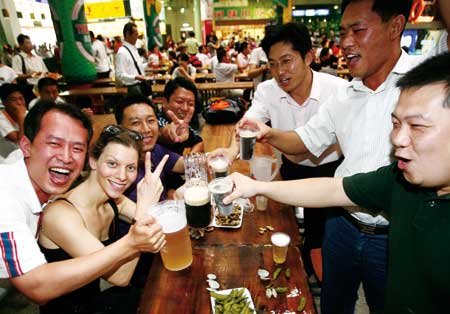
For the next two weeks, tens of thousands of (mostly) Chinese tourists will fill tents at the Qingdao International Beer Festival, singing karaoke, eating spicy seafood on sticks, shouting ganbei and draining their glasses as if drinking beer were a custom as old as Spring Festival.
An observer might imagine that it was draft beer that hard-drinking Tang Dynasty poet Li Bai was imbibing as he danced "A toast to invite the moon, on the shadow into three". So it may seem surprising that beer is just as foreign to China as the German architecture that makes the coastal city of Qingdao so distinctive.
The Germans are coming!
German colonists first opened the Tsingtao factory in 1903, six years after their navy seized the land, formerly occupied by a small Chinese military base and tiny fishing village.
The new arrivals laid out wide streets, grand stone buildings, and an advanced sewer system and electrical grid, as German banks and businesses opened shop in the town (to this day, the local government is partly housed in a former German office building).
This era is nicely captured by photos, blueprints and city plans on display at the original Tsingdao factory's Beer Museum, which also traces the story of the drink's evolution from comfort "food" for homesick colonists to the laobaixing's beverage of choice.
One of their most interesting artifacts is an old electric motor made by Siemens in 1896 and used for stirring the beer vats until as recently as 1995. "Siemens wanted to buy it back," a tour guide said with pride.
But there are some items the Germans probably don't want back, such as the old labels prominently featuring the slogan "Absolutely Pure" alongside a swastika (actually, this was the original Buddhist symbol, our guide assured us, not the inverted swastika the Nazis employed, while the phrase is apparently a reference to beer, rather than racial, purity).


Go to Forum >>0 Comments