|
|
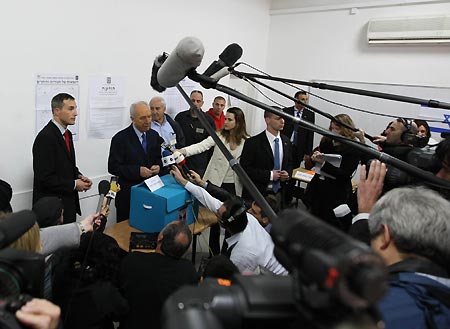
Israel President Shimon Peres receives interviews after casting his vote at a polling station in Jerusalem, Feb. 10, 2009. Israel started a day-long general election on Tuesday morning to choose its next parliament and premiership. [Xinhua Photo]
|
The exit polls overturned the findings of most of earlier opinion polls that indicated the Likud enjoyed a small edge in the run-up to a neck-and-neck race between the two front-runners.
Should Kadima's victory be proved, Livni would very likely receive once again a presidential mandate to form a new government, as the president traditionally assigns the task to the leader of the biggest party in the parliament.
Yet in light of the fragmentariness of Israel's political realm, the cabinet-making mission is doomed to be arduous, as any prime minister-designate has to cobble together a coalition through heavy bargaining.
Shortly before the election ended, Livni said that she is willing to set up a coalition with Likud and Labor. It remains unknown how former prime ministers Benjamin Netanyahu and Ehud Barak, chiefs of the two parties, would react.
Should Livni succeed in forming the government, she would become the second woman premier in Israel's history.
In September, Livni failed to establish a cabinet to replace the caretaker one led by outgoing Prime Minister Ehud Olmert, bringing forth the general election a year ahead of its original schedule.
Until the new government is formed, Olmert, who was forced to resign amid a corruption scandal, will remain in office.
(Xinhua News Agency February 11, 2009)