Old Beijing made for TV
 0
0 


Tonight CCTV 8 will air the final episode of the TV drama Teahouse that, although not ranking high in viewer ratings, has received critical acclaim for its accurate portrayal of life in old Beijing and fidelity to the classic play of the same name.
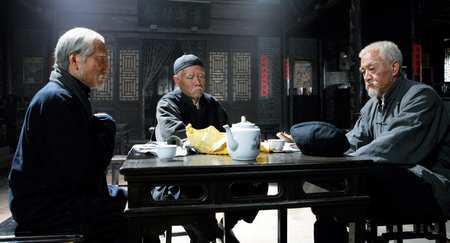 |
|
Scenes from the TV series Teahouse. [Global Times] |
The 39-episode TV series is adapted from the classic stage play Teahouse by famed author Lao She (1899–1966). Set in a typical Beijing teahouse, the play depicts the social changes and thoughts of Beijingers amid the rapid social and political change at the turn of the 20th century.
According to media analyst Zhang Nuo, the recent trend of adapting classical literature to TV has stirred criticism and controversy among media critics, such as the negative reviews for adaptations of the classic Chinese novels Romance of Three Kingdoms and The Dream of Red Mansions.
"People are very picky about classical literature adaptations. To get good reception is very hard," said Zhang.
Li Gongda, producer of Teahouse, further explains these complexities. "The adaptation of classical novels in Chinese TV has recently fallen into two categories," explains Li, "one is to stray too far from the original, which offends some audiences and is seen as ridiculous, the other is to stick exactly to the original in fear of changing the slightest detail, which is criticized as being too conservative."
"It's best to maintain the essence while allowing a certain amount of flexibility," Li added.
According to Li, the team tried their best to preserve the play's old Beijing feel in the TV series as much as possible. The screenplay writers, Ye Guangling and Yang Baoguo, are Beijing natives with curious connections to the play. Ye is a great-grandchild of Qing Dynasty (1644-1911) nobility, while Yang lived his whole childhood only two streets away from the teahouse that is said to have inspired Lao She to pen Teahouse.
"These two writers truly understand the play and write well," said Li, "Also about 80 percent of the cast is from Beijing as well," Li explained.
Well-known actor Chen Baoguo plays the main role of the teahouse owner Wang Lifa. As a native Beijinger, Chen claims that acting in Lao She's work has been a dream since childhood.
"It is not easy to play Wang Lifa, and this acting experience taught me a lot," Chen told the Global Times. "He is a tactful person and always flatters powerful people, but he also maintains his dignity. He represents many Beijing people of that time."
One of the most discussed actors in the TV series is Qian Bo, who stars as Tang Tiezui, a fortuneteller turned Catholic priest. "Talking is only thing Tang Tiezui is good at, so he became a fortune teller. When the foreigners came, he became a priest in order to survive," said Qian.
"I am personally not a talkative person, but I became much more so during shooting. Plus I also went to study fortune telling. I guess that's how I was able to be so convincing."
Yang told the Global Times in order to portray old Beijing vividly, the TV series also focuses on the city's dialect, leisure activities and different mannerisms of the characters.


Go to Forum >>0 Comments