Cornering the market
 0 Comment(s)
 Print
Print E-mail China Daily, March 29, 2013


Christie's and Sotheby's in the major sales rooms of London, New York and Hong Kong are maintaining a buyer's premium of 25, 20 and 12 percent, which means there are more medium- and high-rate lots.
Poly and Guardian will also hold their first Hong Kong spring sales in early April, offering Chinese paintings and calligraphy, antiques, modern and contemporary Chinese art, jewelry and timepieces.
"Chinese auction houses have to charge less to retain their competitive advantages in the international market," says Gong Jisui, a professor at the Central Academy of Fine Arts.
"On the other hand they feel the huge pressure of rising costs and they spend lavishly on previews and promotions. It's going to be unavoidable for them to increase the buyer's premium sooner or later."
He adds Chinese companies will in the future also implement a sliding scale for the buyer's premium and hammer price. "When and how depends on their sensibility to the market and their clients."
Analysts believe auction houses will hold more private sales of medium- and high-priced items. Christie's realized $1 billion of private sales in 2012, an increase of 26 percent on the previous year, while Sotheby's grossed more than $270 million in private sales in 2005. The number surged to $815 million in 2011, and totaled $906.5 million last year.
"Private sales provide tailored services for high-end clients," says Guan Yu, director of the Beijing-based Art Market Monitor of Artron. This changes bidding battles into negotiated price deals.
"The process offers reduced buyer's premiums, in comparison to auctions, and avoids possible transaction risks."
Ching of Sotheby's Asia, however, says the new buyer's premium will not boost private sales.
"Consignors (sellers) and buyers are experienced players in the market. They will compare the possible price fetched at auction with the price they can bargain for at private sales. People also pay a buyer's premium for private sales, which isn't much lower than that of auctions."
 |
|
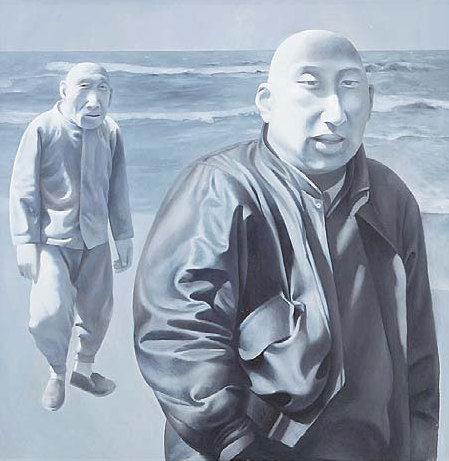
Series 1, No 4 by Fang Lijun. |
He says Asia ranks third after Europe and the United States in private sales volume, and the Chinese mainland ranks at the bottom in Asia.
"Private sales in Asia will increase, but at a slow speed. It relates to the market's maturity."
Mainland buyers make up 30 to 40 percent of Sotheby's Hong Kong customers. But they are not so familiar with private sales compared with other Asian buyers, Ching says.
Whether they will embrace this form of transaction depends on their confidence in and knowledge of the item they purchase, he adds.
"Some buyers are more confident of an open platform, where they can track other bidders and the prices they offer. These are invisible in private sales."
Auction houses are also opening galleries and organizing exhibitions and lectures to improve private sales, which is not one of their traditional working practices. Poly Auction Hong Kong, for example, will open an art center one day before its spring sales.
"We have to meet clients' changing demands," says Alex Chang, Poly Auction Hong Kong's managing director.
"But regarding the level of service, we still differentiate with galleries. Auction houses mainly focus on established artists with a market, while galleries discover and market new talents."
Professor Gong also says there is a clear trend for more private sales, which provide a shortcut for sales and brings in cash while reducing risks. "Auction houses are gradually establishing a monopoly of the art market."


Go to Forum >>0 Comment(s)