Weaving a world of beauty like ancients
 0 Comment(s)
 Print
Print E-mail Shanghai Daily, March 3, 2015


 |
"Changing layers of one color is very hard to weave, and to demonstrate the best effect of stroke needs a lot of experience," Wang says.
In the book "A Dream of Red Mansions" by Cao Xueqin, one of China's four great classical novels, there is a scene describing the debut of Wang Xifeng, one of the principal characters. Wang is tactful, worldly and powerful in the aristocratic family illustrated in the book.
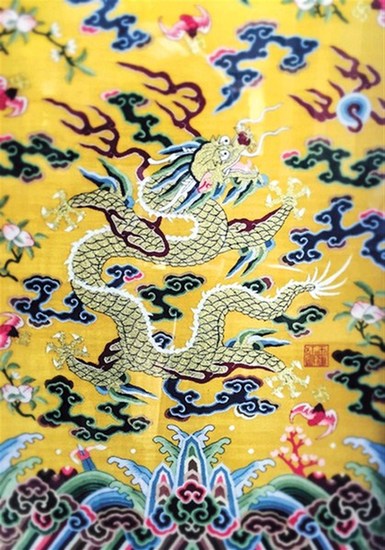
The most capable woman in this novel wears a colored Kesi jacket in her debut scene. In the same novel, red Kesi textile is given to Jiamu (Mother Jia), the most respected character, as a present.
Novelist Cao's great-grandfather and uncle both worked for the textile administrations in Suzhou, so the writer knew the value of Kesi — the ultimate luxury of imperial life and aristocrats.
Old poetry opined that a woman could wear an outfit in Kesi when she arrived at the end of her life, a hint about how long the process of making it took. And there was an old saying, "An inch of Kesi is worth an inch of gold."
The manufacturing process is extremely complex. First, all the warp threads must be fixed to the tapestry loom. Then the pattern from a painting, for example, is placed underneath the flat and even warp threads, and the weavers will use a brush to outline the forms onto the warp.
After that, a bewildering array of colored silks are prepared according to the hues of the prototype that the craftsman needs to separate the color and install them in the shuttle groove. Using dozens of weaving techniques, the weavers then move the shuttle back and forth between the warp threads.


Go to Forum >>0 Comment(s)