Weaving a world of beauty like ancients
 0 Comment(s)
 Print
Print E-mail Shanghai Daily, March 3, 2015


 |
|
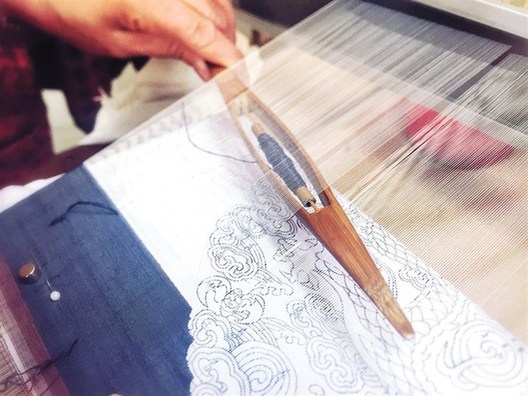
Craftsmen fix the warp threads to loom at Wang Jianjiang’s workshop in Suzhou, Jiangsu Province. With the pattern under the warps, weavers will then use a brush to outline the form. After that, an array of colored silks will be prepared so that craftsmen can start to weave. — All photos by Qu Zhi |
"Sometimes the work is very repetitive and dull but requires the craftsman to be very patient and meticulous," Wang says. "It is indeed an arduous work process that if one has no passion for, they won't persist," Wang says.
There is also no room for error. Because it is woven, it cannot be undone, and a mistake may mean the weavers must start again from scratch.
"It usually takes three years to learn the basic skills of Kesi, while making a good work usually takes over 20 years of apprenticeship and practice," says Wang.
Wang's father, Wang Jialiang, is 76 and still making silk tapestry. "I think my father still does a better job then me, since Kesi requires a lot of experience," Wang says.
He approaches one of the works in his workshop and points at one special Kesi tapestry. It has two base colors — gold on one side and silver on the other. One side has the character for longevity while there is a peach on the other side. One side was woven with silk and the other with gold thread.
"But they (the two sides) are woven on one layer," Wang says.
Created by Wang's father, the family business is the only one among a handful of workshops making Kesi tapestry in China that is able to weave different patterns on the two sides.
"It's a secret that I cannot reveal," Wang says with a smile. "The only one I will teach this skill to is my daughter, who is bound to inherit the family legacy even if she doesn't like it. But luckily she enjoys it."


Go to Forum >>0 Comment(s)