Beijing's unknown railway museum
- By Brian Salter
 0 Comment(s)
 Print
Print E-mail China Today, August 31, 2017


Many residents of Beijing may be surprised if you were to tell them that the capital has three railway museums. Most of them know Zhengyangmen Exhibition Hall, in the old Peking-Mukden Railway Station, on the southeastern corner of Tian'anmen Square; many, too, know of the Eastern Suburb Locomotive Exhibition Hall to the northeast of 798 District, that has over 100 locomotives and rolling stock from different periods of China's railway development. Yet very few have even heard of the Zhan Tianyou Memorial Museum, let alone been there, though it is just a few minutes' walk from the Badaling section of the Great Wall.
|
|
|
Mogul loco used on the Peking-Kalgan Railway. |
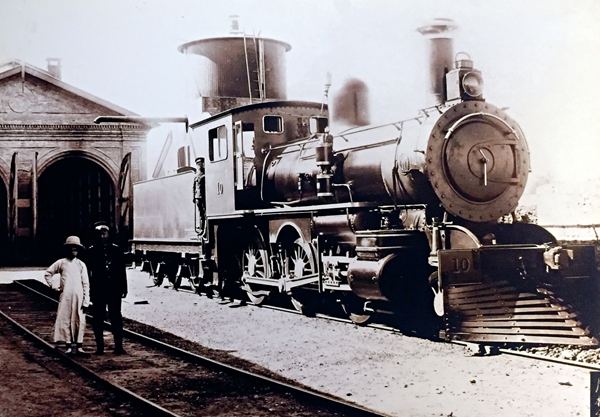
The memorial museum has 9,600 square meters of floor space, arranged over two floors, and outside in front is a large-scale granite relief, some 41 x 5 meters, highlighting Zhan Tianyou's portrait and his contributions to the history of Chinese rail. Inside there are 1,000 items on display, such as mapping instruments, drawing paper, books, manuscripts, medals, insignias, and proposal plans, among other things. There are also some 600 photos, showing not just the life of Zhan Tianyou, but also a general overview of the early days of China's railway construction.
Construction of the museum started in 1984, and it was opened to the public in November 1987. It stands at the highest point along the railway line between Beijing and Zhangjiakou City, close to the Great Wall Museum.
|
|
|
Photo of Zhan taken in 1909. |
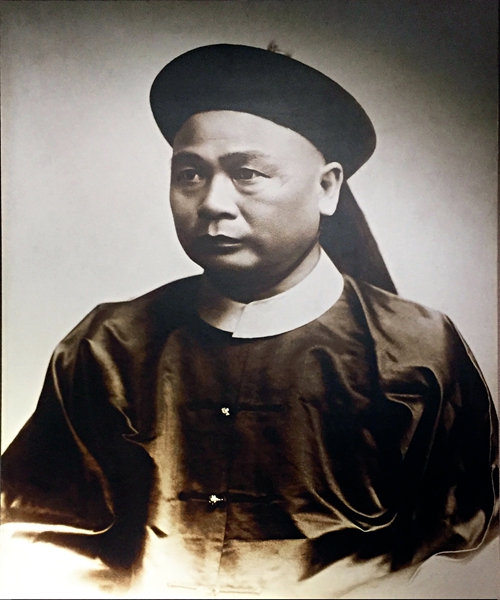
Zhan Tianyou (1861-1919), or Jeme Tien-Yow as he called himself in English, is celebrated as the "Father of China's Railroads." He was born in 1861 in what is now Guangzhou. In 1872, when he was 12 years old, he was chosen – together with 30 boys of the same age – by Qing imperial officials to be sent to the United States as part of the Chinese Educational Mission. In 1878, he entered the Sheffield Scientific School of Yale University, where he majored in civil engineering, with an emphasis on railroad construction.
However, the Qing government officials considered the behavior of the foreign-educated students to be "un-Chinese," believing them to have become too Westernized; and instead of utilizing their education to the full, they were detailed to work as translators or as officers in the newly formed Imperial Navy. Zhan was sent to the Fuchow Arsenal in Fujian Province; but a few years later, in 1884, it was destroyed during the Sino-French War.
In 1888, he became an intern engineer, joining Claude W. Kinder, a British engineer, who had been hired to construct a railway that would link Tientsin (now spelled as Tianjin) with the coalmines in Tangshan. He was soon promoted to engineer, and later to district engineer.


Go to Forum >>0 Comment(s)