Beijing's unknown railway museum
- By Brian Salter
 0 Comment(s)
 Print
Print E-mail China Today, August 31, 2017


Innovative Railway Designs
In 1902, Empress Dowager Cixi (1835-1908) wanted a special 37 km stub line built so she could visit the tombs of her royal ancestors; and eventually, Zhan got the position of chief engineer. He managed to complete the project within budget and to a very tight schedule; and it is said that the Empress was so pleased that permission was given to construct more railways in the country.
 |
|
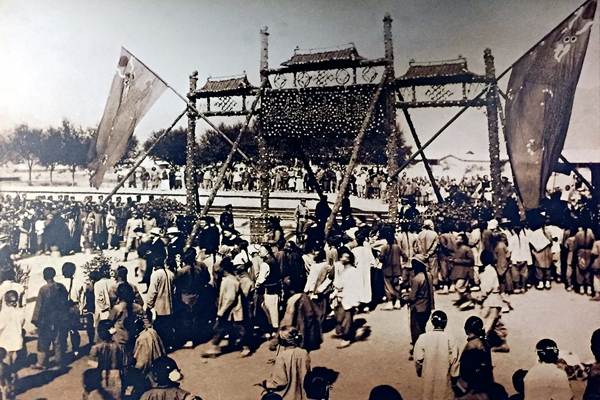
Opening ceremony of Peking-Kalgan Railway in Nankou. |
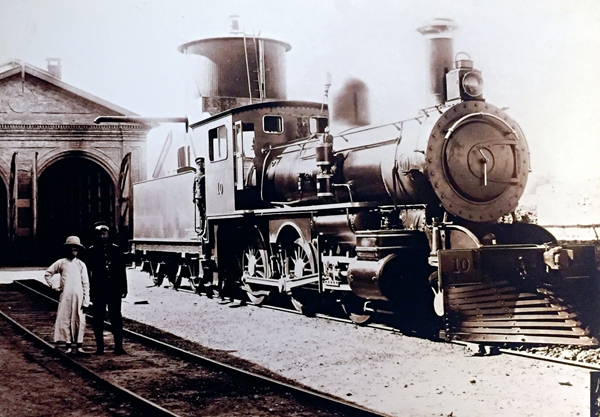
Following that success, the imperial Qing government decided to build a railway that would link the capital of Peking to the important trading city of Kalgan (now Zhangjiakou City) to the north. Because of its strategic importance it was stipulated that no foreign engineers were to be hired. Capital would come from the government, and Zhan Tian-you was once again appointed chief engineer. He managed to complete the work two years ahead of schedule and came in under budget. It was the first trunk railway designed and built by China and ran through Juyongguan Pass, Badaling Pass, Shacheng and Xuanhua, over a length of 201 km.
Zhan included a zigzag section near Qinglong-qiao Railway Station to overcome the steep gradient; and when excavating the Badaling railway tunnel, he accelerated construction by drilling a vertical shaft into the path of the tunnel, thus doubling the number of digging teams that could be employed. Its construction began in September 1905 and ended in October 1909, when it was finally opened to traffic.
|
|
|
Tunnel entrance of Juyongguan Pass at the Great Wall. |
In 1906 Zhan was also a technical advisor for the construction of the Lo Wu Bridge, which was built as part of the Kowloon-Canton Railway. In 1909, Zhan was elected to become a member of the North British Academy of Arts and also to the American Society of Civil Engineers. He was also a founding member of the Chinese Institute of Engineers, and was awarded an honorary doctorate by the University of Hong Kong in 1916.
|
|
|
Qinglongqiao Station. |
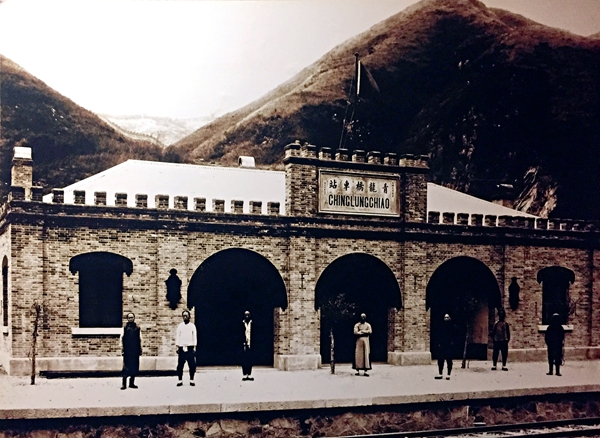
He worked on many other railways in his time; but in 1919, Zhan Tianyou died in Hankou, Hubei Province, at the age of 57. His final resting place was at Qinglongqiao Railway Station, where the Peking-Kalgan Railway crossed the Great Wall.
Brian Salter is a broadcaster and journalist who has been working in China for the past five years.


Go to Forum >>0 Comment(s)