CPC seeks international opinions in self-purification
- By Chen Boyuan
 0 Comment(s)
 Print
 E-mail China.org.cn, September 16, 2015


The Communist Party of China (CPC) has found itself in the limelight because of its intensifying anti-corruption campaign which started in 2013, after China's new leadership headed by Xi Jinping took office. In the anti-corruption campaign aimed at self-purification, the Party's disciplinary watchdog, the Central Commission for Discipline Inspection (CCDI) has so far brought down a handful of Party and government officials, both senior and petty, better known as "tigers and flies."
|
|
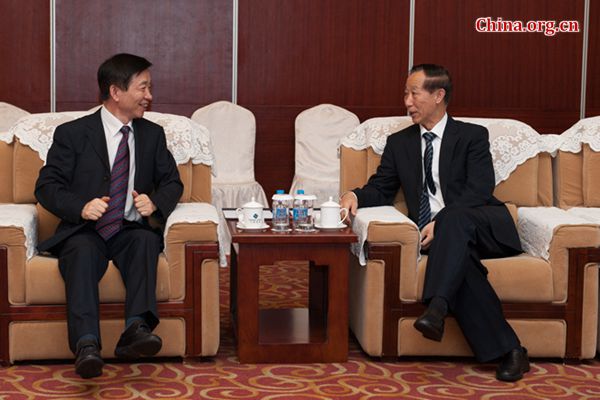
| Vice Chairman of the Chinese People's Political Consultative Conference (CPPCC) and IDCPC Minister Wang Jiarui (R) meets with Huang Shuxian, Minister of Supervision (L) at "Party and the World Dialogue 2015 – To Discipline the Party: Responsibility of the Party, which is held on Sept. 8, 2015 in Beijing. [Photo by Chen Boyuan / China.org.cn] |
While the Chinese public has witnessed the CPC's resolve for a clean government, as well as its frankness in admitting that corruption is a serious issue in the country, the international community has still yet to be informed of just how the CPC, the only ruling Party of China, will carry out this self-purification as a means of achieving self-perfection. In other words, the CPC has a need to strengthen communication with the world in order to discuss its anti-corruption measures, including those successful experiences worth sharing and the many obstacles that require outside assistance.
The annual Party and World Dialogue, launched for the first time last year, was just such a communication-enhancing event. Party and the World Dialogue 2015, themed around "To Discipline the Party: Responsibility of the Party," which was held jointly by the China Center for Contemporary World Studies (CCCWS) of the International Department of the CPC Central Committee (IDCPC) and the International Cooperation Department of CCDI in Beijing on Sept. 8-10, offered a platform for Chinese and International parties as well as government officials and scholars to discuss how party discipline and state laws could cooperate with corruption reduction, and how different countries should consolidate their cooperation in fighting corruption, a global evil.
The demand for disciplining the party lies in the nature of the CPC. In the CPC, a 94-year-old party which has been in power for 66 years, bureaucracy and formalism are prone to take root, which often leads to corruption when Party members and officials fail to live by discipline and law, or when supervision becomes ineffective.
"If the Party has too many corrupt officials, the people will desert us. The CPC was chosen as the ruling party by the people and we don't have an opposition. There's no such political soil or historical background in China for different parties to take turns to rule. No party can replace the CPC. Hence, the only way to solve the problem is to purify, perfect, reform and discipline ourselves," said Wang Jiarui, head of the International Department of the CPC Central Committee.
He said that the intensified anti-corruption campaign has been effective, also saying "this is why the CPC will not lose its people and the people will continue to support us." Hosting the Party and World dialogue was a means to seek opinions, including criticism, "as long as they are kind-intended."
China's anti-corruption drive also features the tightening up of intra-Party disciplines, including the provision that Party members are not allowed to hold extravagant weddings and funerals, among other activities not actually prohibited by law.


Go to Forum >>0 Comment(s)