CPC seeks international opinions in self-purification
- By Chen Boyuan
 0 Comment(s)
 Print
 E-mail China.org.cn, September 16, 2015


|
|
| Wang Shaoguang, Chair Professor in the Department of Government and Public Administration at the Chinese University of Hong Kong, China makes a comment on the relations between 'Party disciplines and state laws' at a panel discussion on "Governing the Party according to rules," during the "Party and the World Dialogue 2015 – To Discipline the Party: Responsibility of the Party" on Sept. 8, 2015 in Beijing. [Photo by Chen Boyuan / China.org.cn] |
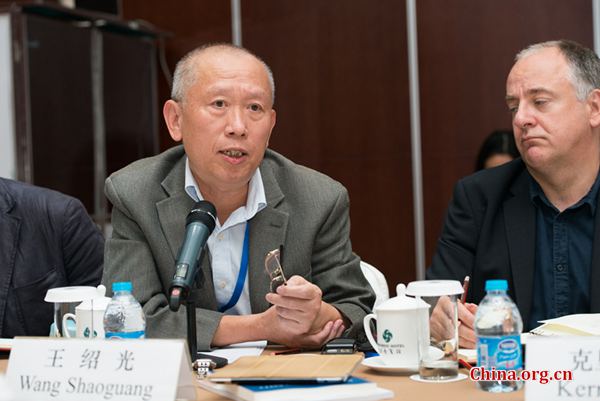
Similarly, to strictly discipline the Party should not simply rely on the Party's disciplinary agencies, "but on the 87 million Party members among the 1.3 billion Chinese people," according to Wang Shaoguang, Chair Professor in the Department of Government and Public Administration at the Chinese University of Hong Kong. He also pointed out that intra-Party disciplinary punishment measures are not specific enough when compared to legal penalties, which amounts to difficulties in properly punishing Party members in disciplinary violations.
One unique anti-disciplinary violation measure is called shuanggui, an intra-Party investigation and interrogation process that demands a Party member who is suspected of corruption, among other connotations, to confess at a "designated time" and a "designated location."
Such disciplinary processes are a matter of controversy and dispute as they often incur the detention of Party members under investigation for suspicion of disciplinary violations.


Go to Forum >>0 Comment(s)