CPC seeks international opinions in self-purification
- By Chen Boyuan
 0 Comment(s)
 Print
 E-mail China.org.cn, September 16, 2015


As for these kinds of differences, senior CPC officials attending the Party and World Dialogue, including Huang Shuxian, deputy secretary of the CCDI and Minister of Supervision of China, interpreted them by saying, "Party discipline is stricter than the law, but the law is superior to Party discipline," meaning that Party members have to abide by a stricter code of conduct or "face the consequences."
|
|
| Jiang Licheng, Deputy Secretary of Jiangsu Provincial Discipline Inspection Commission of Jiangsu Province and Director General of Jiangsu Provincial Bureau of Inspection talks about his view on tightening discipline for Party members on Sept. 8, 2015 in Beijing. [Photo by Chen Boyuan / China.org.cn] |
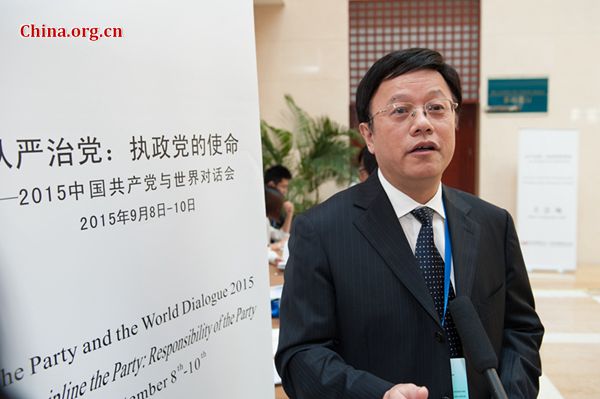
"We used to compare this gap [between Party discipline and the law] to relay race training," said Jiang Licheng, Deputy Secretary of the Jiangsu Provincial Discipline Inspection Commission and Director General of the province's Bureau of Inspection, on Sept. 8 at the Party and World Dialogue.
"The relay zone during training is smaller than that of actual races. Runners accustomed to stricter zones are less likely to break the rules during actual races. This is how we discipline the Party members," said the provincial discipline chief, adding that observing Party discipline that are stricter than China's state laws could help preserve Party officials' integrity and therefore increase the public's confidence in them.
Most people might take it for granted that tightening up Party discipline amounts to busting corrupt officials, especially those in major cases. However, discipline watchdog officials such as Jiang as well as scholars of social governance believe that strictly disciplining the Party lies in "stepping up daily supervision to prevent trivial misconduct from happening."


Go to Forum >>0 Comment(s)